


I've spent the better part of two decades working with values — running workshops with organizations like PwC, Shell, Electronic Arts, building the Values Institute, and writing Start With Values (Penguin, 2025). In that time, I've tried just about every values assessment on the market. Some are genuinely excellent. Some are dressed-up personality tests with the word "values" bolted on.
This guide is my honest take on the best free options available right now — what they are, what makes them worth your time, and who they're best suited for. I've kept the research context in because it matters, but this isn't a textbook. It's a recommendation from someone who lives and breathes this stuff.
Jump straight to the ranked assessments ↓
If you've never really thought about why values assessments work, the context below is worth two minutes of your time.
Why discover your values?
Most of us have felt it — that low-level friction when something in our work or life doesn't sit right. We can feel the misalignment before we can name it. Sometimes we call this feeling "stress" — and it runs in the background, slowly draining our battery. The end state of chronic values misalignment is... burnout.
Values work is the process of discovering what matters and then being more intentional about aligning our lives around these values.
What I've seen consistently, across thousands of workshop participants, is that people don't need to overhaul their lives once they get clear on their values. They just need to see more clearly. Values don't tell you to quit your job or end a relationship. They give you the self-awareness to make small, deliberate shifts toward a life that actually feels like yours.
Some people are resistant to this kind of reflection — worried, perhaps, about what they might find. I'd gently push back on that. In my experience, clarity is almost always a relief, not a crisis. Using a well-designed assessment dramatically shortens the process of getting there.
Here are a few things that tend to shift when people get clear on their values:
- Self-awareness. You start to understand not just what you do, but why. That distinction changes everything — from how you make decisions to how you manage stress.
- Goal-setting and decision-making. Goals set without values are easy to abandon. Goals that express your values are genuinely motivating. The difference is significant.
- Relationships. Understanding your own values makes you a better listener and a clearer communicator. It also makes conflict easier to navigate — because you can see what's actually at stake for yourself and the other person.
- Behavior change. Values-based micro-habits help us overcome resistance to change by gradually scaling up positive habits into our daily routine.
Start with values discovery → create micro-habits → make clearer decisions → increase trust and connection.
A brief history of values assessments
Humans have been wrestling with what matters most for as long as we've been thinking. But the formal study of values took shape gradually across the 20th century, through the work of psychologists like Carl Jung earlier on and, later, Abraham Maslow — though neither set out to build a formal "study of values" in the way researchers after them would. It wasn't until the late 1960s and early 1970s that values assessments became a genuinely structured tool, thanks largely to social psychologist Milton Rokeach, whose Rokeach Value Survey — introduced in his 1973 book The Nature of Human Values — laid the groundwork for much of what followed.
Since then, the field has evolved significantly — from paper-based surveys to AI-driven personalization tools. The underlying question hasn't changed: what do you actually care about, and are you living accordingly?
Research into values assessments
The research is clear and consistent. Values assessments work.
Norman Feather's research program at Flinders University, starting with his 1975 book Values in Education and Society and continuing through the 1980s, used the Rokeach Value Survey to compare value priorities across cultures — including Australia, Papua New Guinea, and China — and lent real weight to its cross-cultural applicability. Meglino and Ravlin's (1998) influential review of the person-organization values literature found that value congruence with one's organization is associated with greater job satisfaction and more positive work attitudes. Sagiv and Schwartz (2000) showed a meaningful link between values orientation and well-being — with people who prioritized self-transcendence (contributing to others, the world) reporting higher life satisfaction than those focused primarily on self-enhancement.
More recently, a 2005 study by Creswell, Welch, Taylor, Sherman, Gruenewald, and Mann, published in Psychological Science, found that people who actively affirmed their personal values showed significantly lower cortisol responses to a lab stress challenge. This isn't soft science. Values clarity is a genuine resilience and well-being enabler.
Free values assessments
In August 2026 I sat down and tested every assessment on this list myself, start to finish, results screens included. The ranking below reflects what you actually get on each free tier, not what the marketing pages promise, and prices are as tested in August 2026. One disclosure up front: the top pick is ours. We build the Values App, so read that entry knowing I'm biased — it's also exactly why I went and tested everything else. Every tool is scored out of 5, ours included — with the disclosure right beside the score. (And if you just want to browse values rather than take an assessment, the 149 core values list is there for that.)
1. The Values App — Values Institute · our pick
★★★★★5/5 — it's ours, and we stand behind this rating
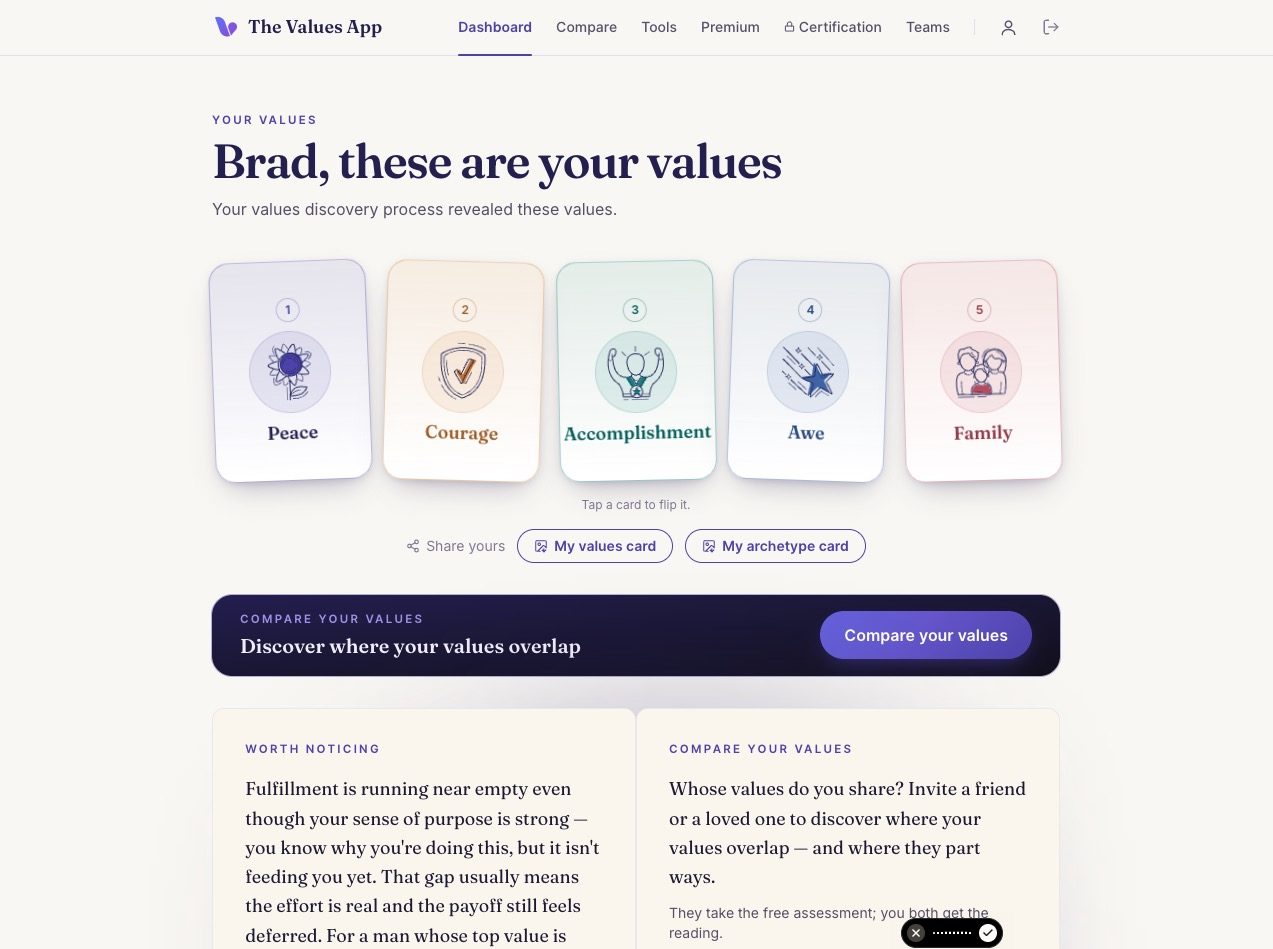
The Values App uses statements rather than value names, so you understand what each value really means before you choose it. The discovery process is broken into four short lists rather than one long one, and a pairwise comparison settles your ranking. It also reads your well-being alongside your values — none of the other tools here do that.
The free tier gives you more than anything else on this list: your Values Story, your archetype, an inner-versus-outer-world rating, and the ability to compare values with someone else — no ID numbers or codes, just a simple invite. You also get three built-in tools: a values-based decision matrix, The Gentle No (for declining things kindly), and a junk values audit. Premium is a one-time $29.95 and adds a comprehensive course and a range of deeper features.
Your top five are free, no sign-up required, in about three minutes — and every user can download a designed PDF report of their results (see a sample). (Prefer a lighter framing? The same engine powers our free values quiz.)
2. Values Navigator — Azimuth Psychological
★★★★★4/5
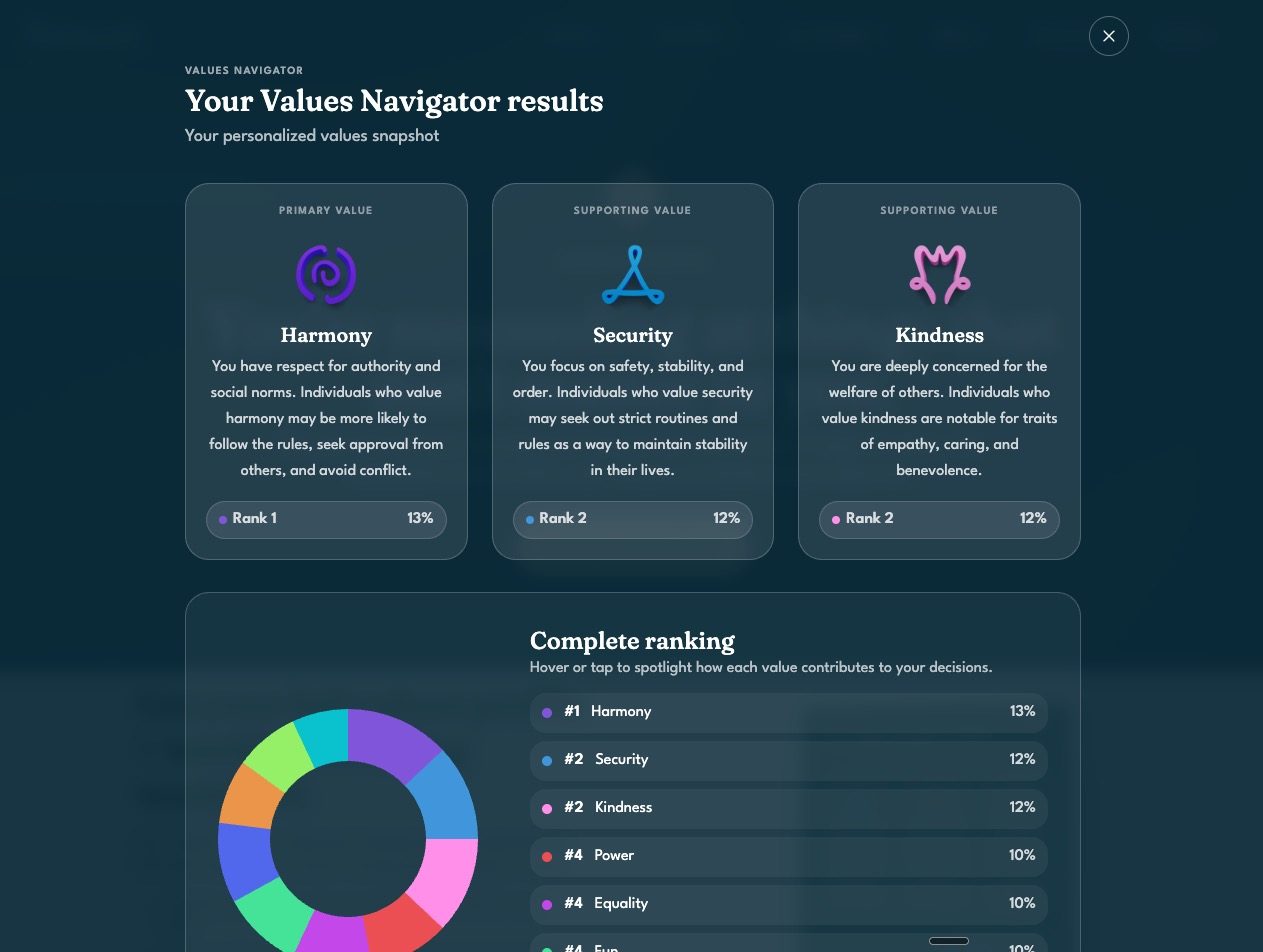
Genuinely free, and by far the next best tool on this list. It's built on Schwartz's Theory of Basic Human Values — 21 questions, 10 to 15 minutes. You get a personalized snapshot with your top three values, a complete ranking with a nice radial chart, and a values profile that works like a light archetype. The downloadable workbook is really, really good — the best PDF of the bunch. There's an iOS app, and you can schedule a free consultation with them.
3. Core Values Assessment — Personal Values
★★★★★3/5
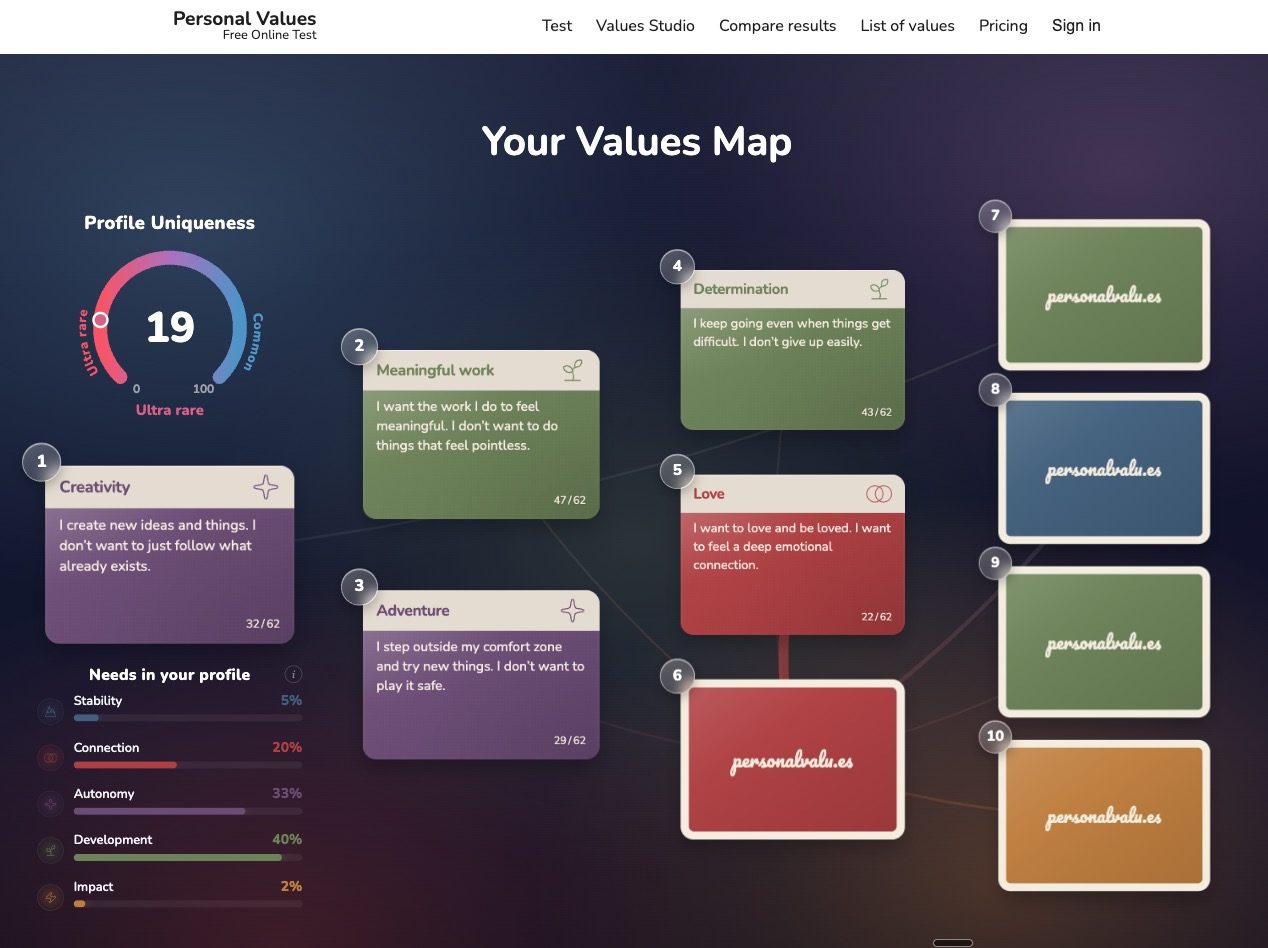
What I like is the speed at which you get to your values. What I dislike is the very long list of value cards — it's a bit overwhelming, and you may be feeling decision fatigue by the time you reach the bottom. The pairwise comparison is good, and the free PDF report is genuinely nice. You see your top five free; values six through ten sit behind a $14.99 unlock, and an unlimited profile is $29.99. From my perspective the top three to five are what matter anyway — try to make decisions with more than five values and you'll run into all kinds of hierarchy challenges. There's also a Values Studio with a huge range of value cards, which is again a little overwhelming. A fast, effective tool that doesn't give you much beyond your top five; my suggestion for them would be to group values by their dimensions in the discovery process.
4. The Values Bridge — Becoming You Labs
★★★★★2/5
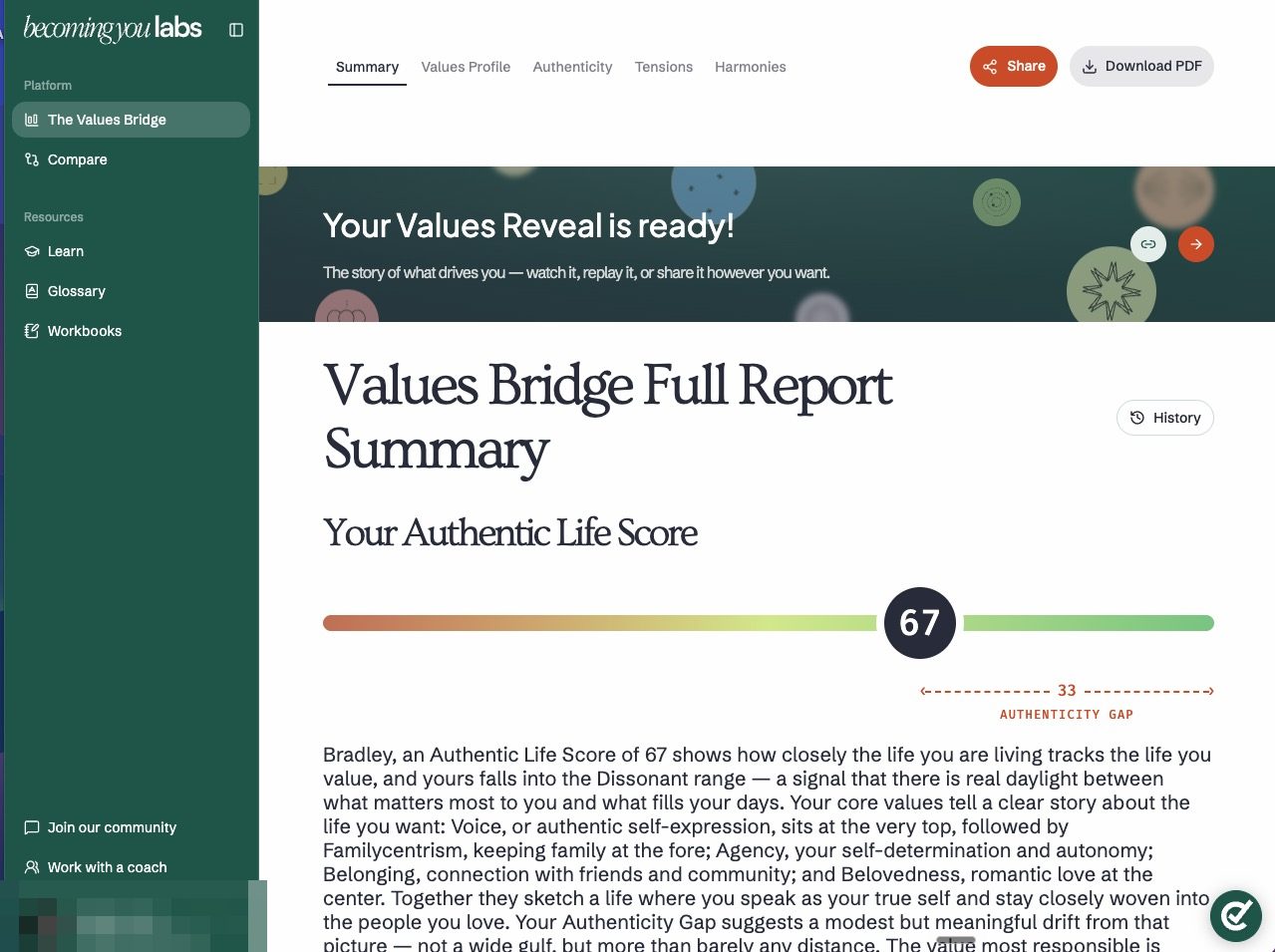
The question process is pretty heavy — decision fatigue again — but the interface is nice and modern. You land on a dashboard with an Authenticity Score and an authenticity gap showing how far you are from living authentically; I'd want a little more context on what these mean. There's a value synthesis statement, and you see your top value — but only your top value. The second and third are locked. What's currently happening in your life: one shown, the rest locked. The PDF download is locked. Everything except your top value sits behind a $49 unlock, which also reveals your bottom values. There's a compare feature. A fine experience, but be prepared to pay to get the most out of it.
5. Life Values Inventory
★★★★★2/5
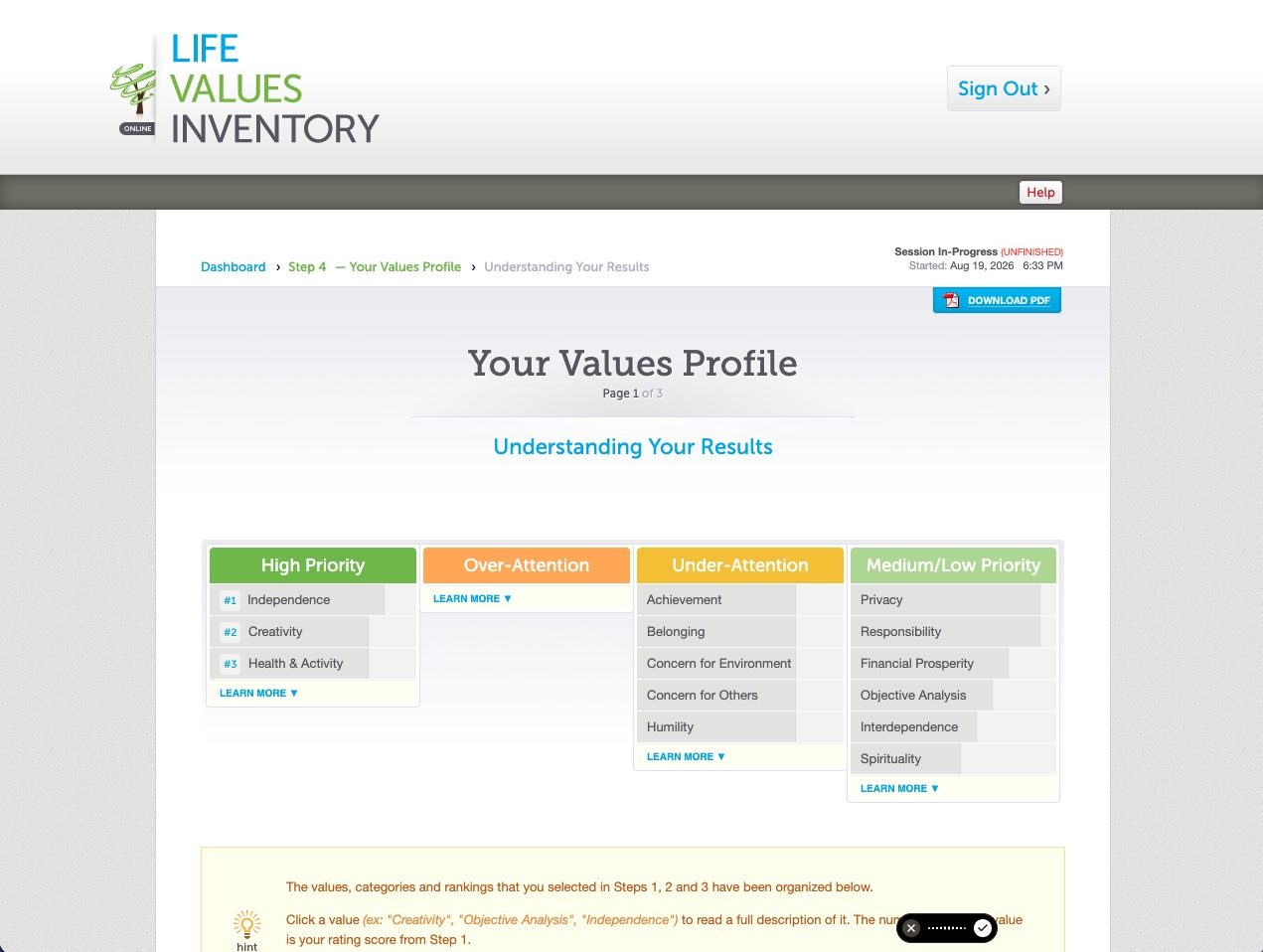
Co-developed by psychologists Duane Brown and Kelly Crace, this one is not bad — but it feels a little dated, and the discovery process is heavy. It takes quite some time to reach your dashboard; personally, I started losing hope along the way. It does give you your top three values with quite a lot of information about each, and the categorization is genuinely interesting: values getting too much attention, values not getting enough, and medium-low priority. That framing may give you some clarity — overall, I found it a little confusing. Free.
6. Values Exercise — think2perform
★★★★★2/5
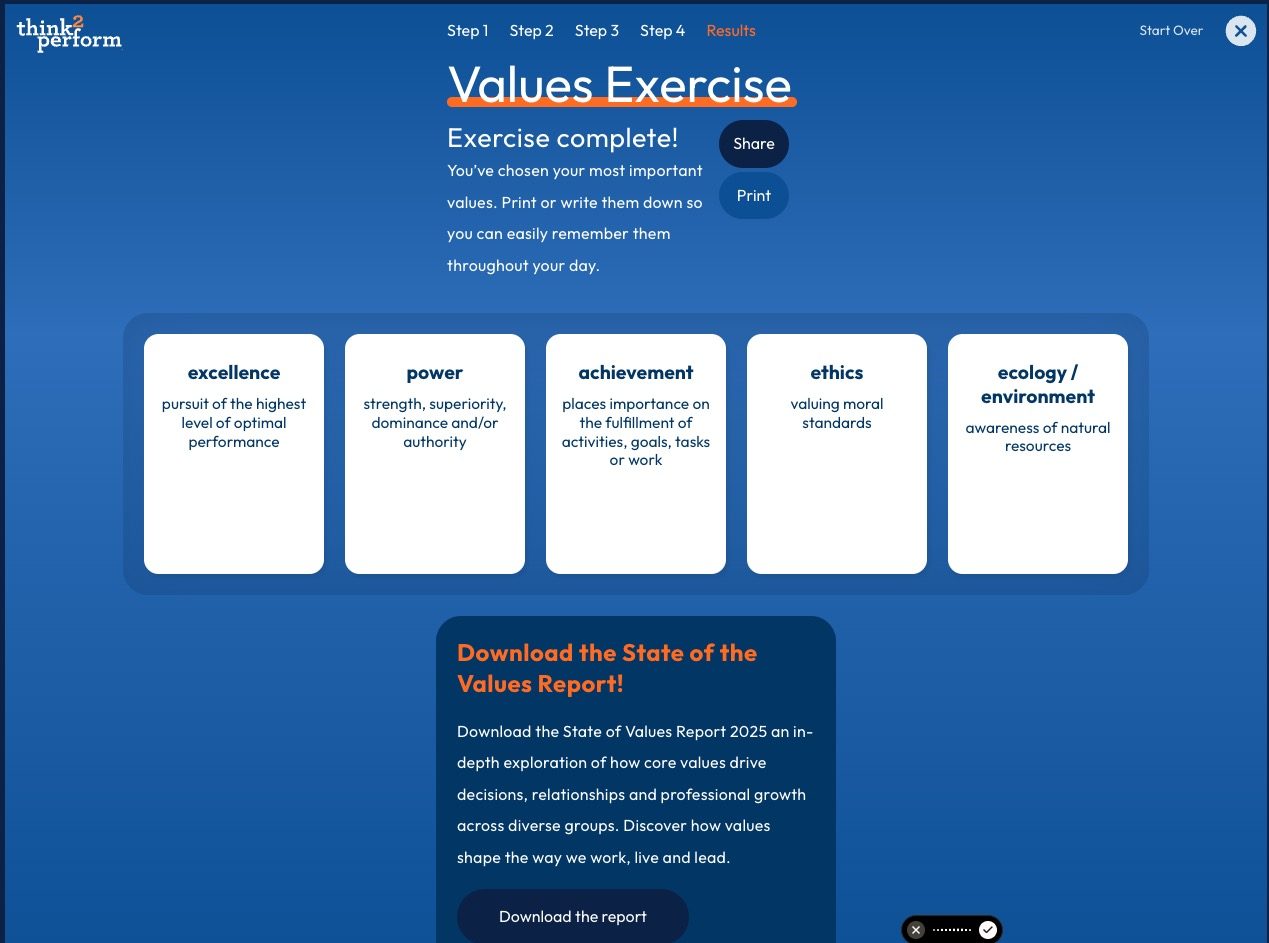
Very simple — it feels a little like being on Tinder. You swipe values left or right, filter to your top 15, then your top 10, then your top five, and that's it: a screen showing the five values you selected. Super simple, but fine for what it is.
7. The Core Values Quiz — Life Note
★★★★★2/5
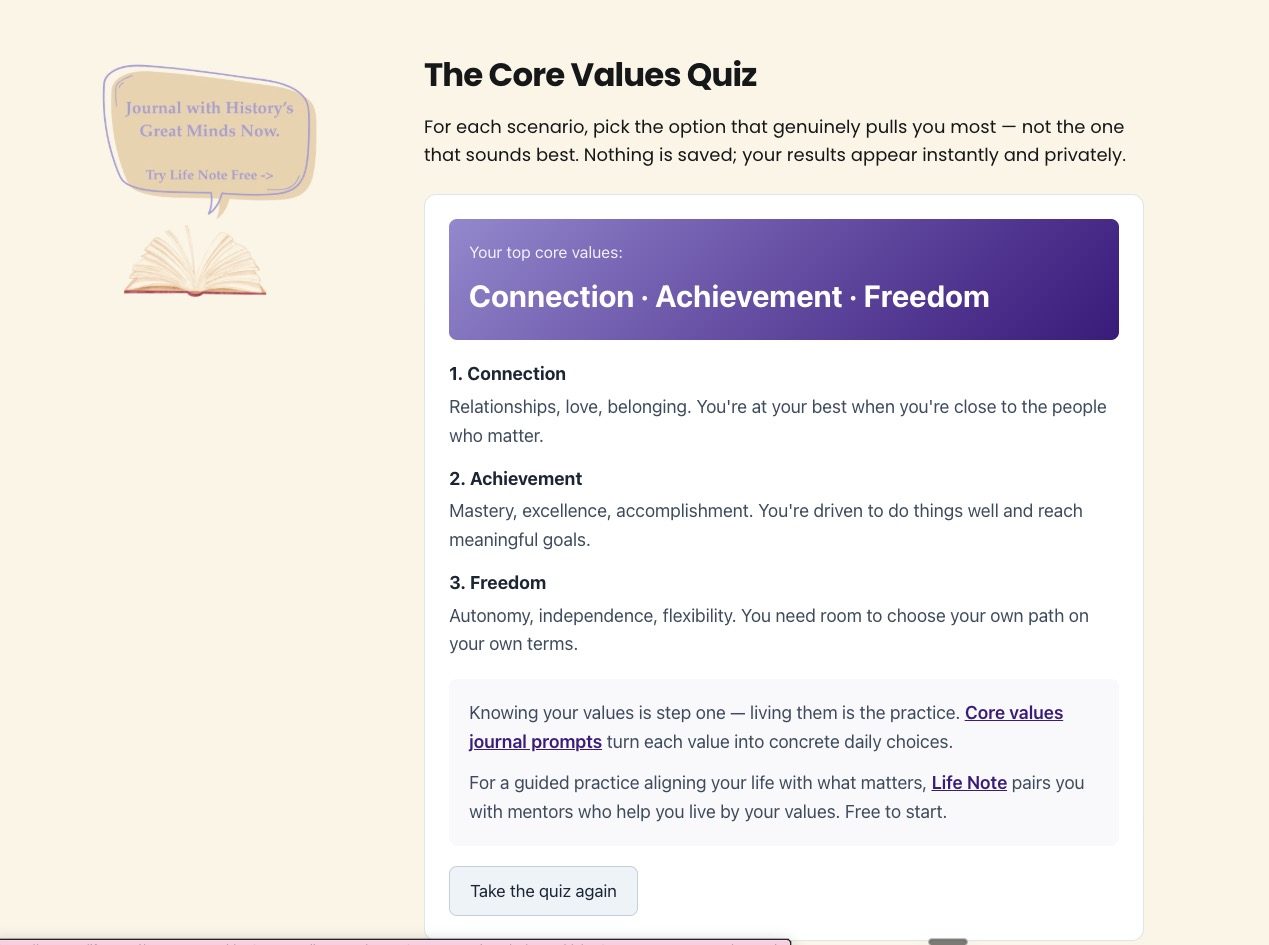
Really simple — it almost feels like a Typeform. You answer scenario questions and it gives you your top values instantly; nothing is saved. If you want no fuss and super fast, this is a useful quick tool.
Not free, but worth mentioning
Two established tools didn't make the ranking because they're not actually free (as tested, August 2026): the Personal Values Assessment from Barrett Values Centre gates its results at $19.95, and the Core Values Index from Taylor Protocols runs $49.95. Both are respected, particularly in organizational and coaching contexts — just go in knowing you'll pay.
Related, but not a values assessment
The VIA Character Strengths Survey measures 24 character strengths rather than values, so it doesn't belong in this ranking — but there's meaningful overlap, and strengths and values together give you a richer picture of who you are. Free, with a solid feedback report.
Conclusion
The point of all this isn't the assessment itself. The point is what you do after.
In my work — and in the research that underpins Start With Values — the gap isn't between people who know their values and people who don't. It's between people who know their values and people who live them. That's the harder, more interesting work.
Any of the tools above will give you a starting point. The Values Assessment is designed specifically to bridge that gap — to move you from insight to action. But the best assessment is the one you'll actually complete and reflect on honestly.
Start somewhere. Start today.
Discover your own core values
The free, research-backed Values App assessment reveals your top five in about three minutes — no sign-up required.
Take the free assessment