
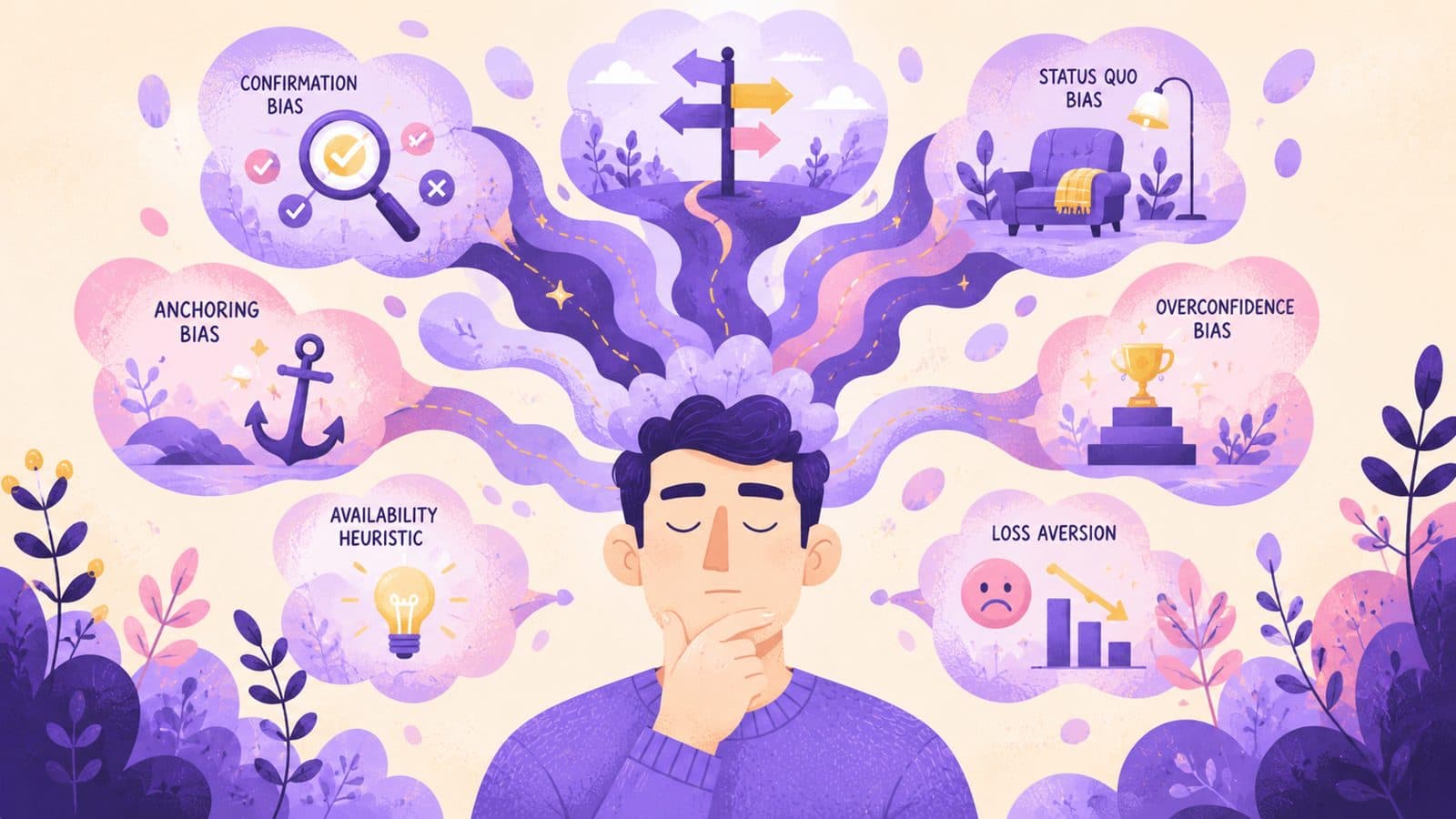

In Start With Values I make a case I'll happily repeat forever: clear values cut through the noise of a hard decision. But there's a catch I promised readers a deeper look at, and this is that page. Your values can't guide a decision that your biases have already made.
Here's the uncomfortable truth: the brain isn't a truth-seeking machine. It's a prediction machine built for speed and survival, and it leans on shortcuts — heuristics — to get through the thousands of choices a day life throws at it. Most of the time those shortcuts serve us. But under pressure, or in unfamiliar territory, they quietly bend our decisions away from what we actually value — while leaving us fully convinced we chose freely.
So think of this as a field guide. Nine of the most common biases, what each one does to a values-based decision, and the counter-move for each.
Confirmation bias: you find what you look for
We favor information that supports what we already believe, and quietly discount whatever doesn't. If you've half-decided to take the job, you'll notice every article about bold career moves and skim past the ones about burnout.
Why it matters for values: confirmation bias lets you believe a choice is values-aligned because you've only collected the evidence that says so. If family is a core value and you want the promotion anyway, you'll find a dozen reasons the extra hours "won't really affect home life."
Counter-move: argue the other side, in writing. Give the opposing case its best lawyer for ten minutes. If your choice survives honest opposition, it's probably real.
Anchoring: the first number wins
Whatever information arrives first becomes the reference point everything else is judged against. The first salary figure mentioned, the first house you viewed, the first opinion in the meeting.
Why it matters for values: anchors hijack your priorities before your values get a vote. A big number early in a negotiation can make wealth loom larger in your thinking than it actually ranks in your life.
Counter-move: name your values before you look at the options. That's the entire logic of values-based decision making — set the criteria first, so the anchor lands on ground you've already prepared.
The availability heuristic: vivid beats true
We judge how likely something is by how easily examples come to mind. Shark attacks feel common because they make the news; the far larger everyday risks don't. Fear of a dramatic, memorable outcome can push us away from choices that are genuinely aligned with what we value — and toward "safe" options that quietly cost us.
Counter-move: ask, am I reacting to the odds, or to the story? Where you can, look up the actual base rate. The vivid scenario is almost never the likely one.
The sunk cost fallacy: throwing good years after bad
The more we've invested — money, time, identity — the harder it is to walk away, even when walking away is clearly the values-aligned move. It's why people stay a decade in careers they chose at twenty-two with values they no longer hold.
Counter-move: ask the zero-based question: knowing everything I know now, would I choose this today? If the answer is no, the past investment is a memory, not a reason.
Loss aversion: losses roar, gains whisper
The research tradition founded by Daniel Kahneman and Amos Tversky showed that losses loom roughly twice as large as equivalent gains. We'll fight harder to avoid losing $100 than to win $100 — and harder to protect a mediocre status quo than to reach for something better.
Why it matters for values: growth-oriented values — adventure, learning, contribution — almost always require risking a loss somewhere. Loss aversion votes for the cage every time.
Counter-move: flip the frame. Instead of "what do I risk by changing?", price the other side: what am I losing every month by staying? Misalignment has a running cost; it's just quieter.
Status quo bias: the comfort of the current
Close cousin to loss aversion: whatever is currently true feels safer than any alternative, purely because it's current. In the book I call the underlying force homeostasis — the body's drive for stability that protects us brilliantly and plans terribly.
Counter-move: treat "change nothing" as an option like any other, and score it. In the Decision Matrix, "stay where I am" gets its own column with its own reasons — and it has to earn its points like everything else.
Social proof: everyone's doing it
When we're uncertain, we look sideways. What the crowd chooses starts to feel correct, and what family or peers expect starts to feel mandatory. There's an entire failure mode here I write about separately — people-pleasing — where decisions stop expressing your values and start managing everyone else's expectations.
Counter-move: the question from the book: who's writing the story of my life? Get clear on your answer before you consult the crowd.
Affinity bias: when gut feel is just familiarity
Here's the example I use in the book. A hiring manager picks the candidate who went to their own college — not because the school signals competence, but because familiarity feels like fit. That feeling is real; it's just not information. Unconscious biases like this can dress themselves up as intuition, echoing old prejudices and comfortable patterns while claiming to be gut instinct.
Counter-move: intuition is worth listening to — it's often your values speaking through experience — but fact-check it. Ask: would this feel like the right call if the surface details were different? If the candidate had a different accent, the house a different suburb, the offer a different logo?
Overconfidence: certainty is not accuracy
We routinely overrate our knowledge, our forecasts, and our immunity to every bias on this list. (Ironically, learning about biases tends to make people more confident they don't have them.)
Counter-move: borrow eyes. Show your reasoning to someone who'll disagree with you comfortably, and set a review date — the step people always skip. Future-you, looking back honestly, is the best bias detector there is.
Bias-proofing a decision: a short routine
You can't delete these biases — they're wiring, not habits. But you can build decisions that route around them:
- Calm down first. A stressed brain narrows to survival mode and amplifies every bias in this list. Settle your nervous system — or try a short values-based meditation — before deciding anything that matters.
- Name your values before the options. Criteria first, evidence second. That neutralizes anchors and starves confirmation bias.
- Make the reasoning visible. Vague feelings hide biases; explicit reasons expose them. The free Decision Matrix — the tool from the book — forces every option to state its reasons and score them against your values. Weak, bias-driven reasons look weak on paper.
- Give the other side its day in court. Best argument against, in writing.
- Set a review date, then actually review. Biases flourish where feedback never arrives.
Your values are the most reliable decision instrument you own. This routine keeps the lens they look through clean.
Discover your own core values
The free, research-backed Values App assessment reveals your top five in about three minutes — no sign-up required.
Take the free assessment