
The Values App
Discover your values. Then bring them to life.
The Values App starts with a research-backed assessment that reveals your top five values in about three minutes — free, no sign-up required. Then it keeps going: a few more questions unlock your archetype, well-being insights and a personal dashboard, with a course and tools to help you close the gap between knowing and living.
Start the free assessmentFree · top five in ~3 minutes · no sign-up required
Spirituality
Fulfillment
Status
Impact
Courage
Growth
Stability
Growth
Leadership
Impact
The reveal moment — a sample top five. Yours takes about three minutes.
How the assessment works
A values test built on trade-offs, not self-ratings
Answer the questions
A few minutes of guided trade-offs drawn from a proven values framework — you choose between values, one pair at a time. No sign-up required.
Reveal your top values
See the handful of values that matter most to you, and learn how to bring each one to life.
Explore your Dashboard
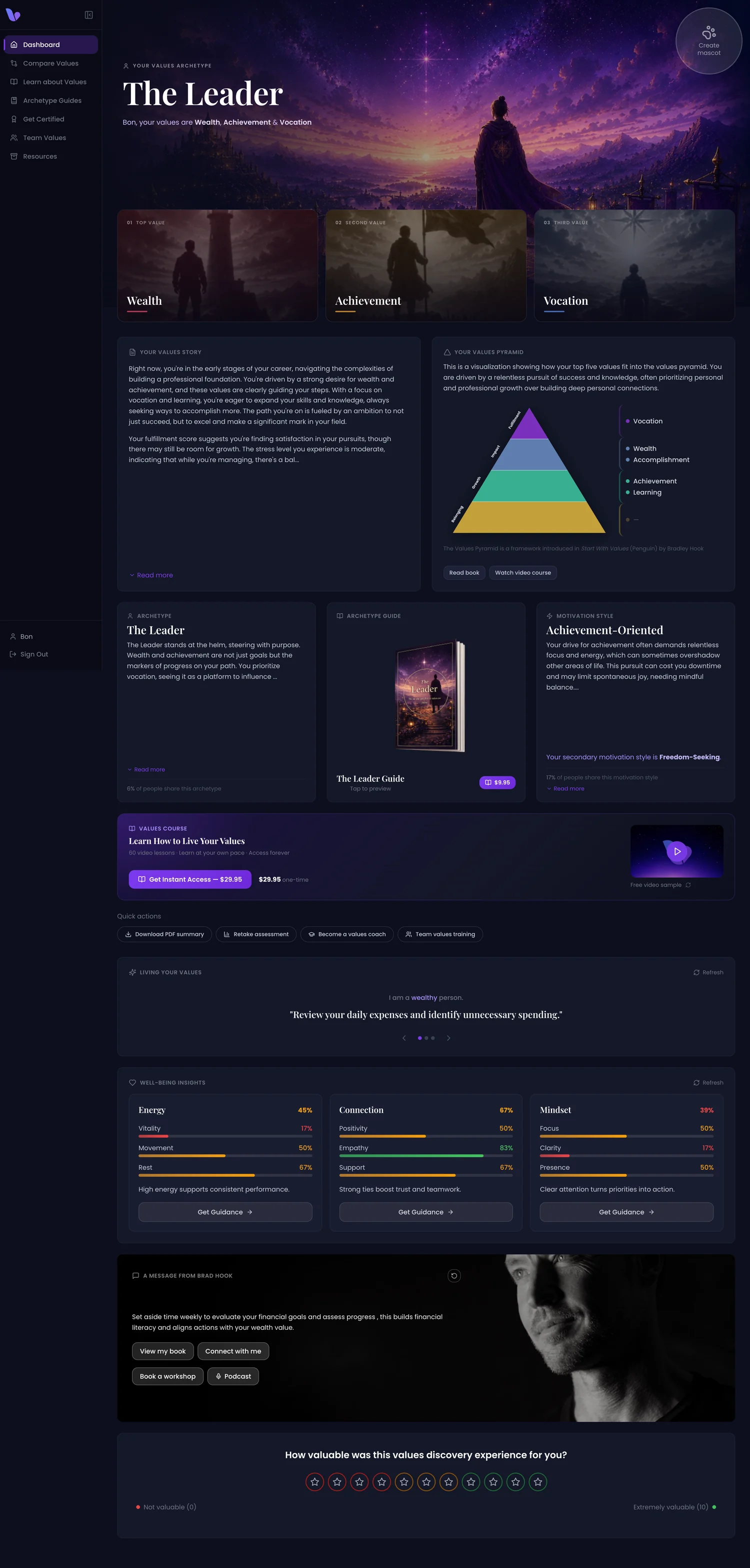
Your results live in a personal dashboard: your Values Story book, your archetype, your well-being read, and tools to compare values with people you care about.
See it in action
Watch the full walkthrough
Brad walks through everything on this page in twenty minutes: the assessment, your dashboard, comparing values, the free tools, and what Premium unlocks.
Read the full transcript
Hey there, I'm Brad Hook, the founder of the Values Institute. I'm also a speaker who works with companies all around the world and I've written a few books. Today, I'm going to give you a walkthrough of the Values app, which is a tool that my team and I have created over several years in order to help people discover their values for free along with actionable insights to help you bring your values to life. Because it's one thing to discover your values and get clear about what matters to you, but there's a very real values living gap. In fact, we analyzed nearly 10,000 values assessments and discovered that even people with the highest levels of values clarity are struggling to live in alignment with their values because they don't have the capacity. They're feeling depleted. So, our mission is to help people not only discover their values, but to learn how to bring them to life so that you make better decisions based on your specific values. That you reduce uncertainty because you know that you have these anchors, these values that will guide you, especially in times when everything seems to be changing all around you. And your values are something that you can use in relationships to really understand how you differ from someone else because often friction comes as a result of values misalignment. And when you're clear about your values, about someone else's values, you can have better conversations, more courageous conversations, more respectful, authentic conversations, and it can relieve a lot of the distress that we would otherwise just experience in our work and lives. So without further ado, let's jump in and explore the Values app. I'm looking forward to showing you around. So from the homepage of the Values Institute website, click on Values app and start the free assessment. Let's start now with a brand new fresh account. So first and foremost, you'll be presented with four lists of values. We've deliberately segmented them to make it easier to answer or select from the lists. Some of those lists that you'll find out there are a little overwhelming. So, let's see what is most valuable to me. What matters most. Let's just say in this demo that I choose loving and being loved and my family. You can select up to three from any one of these four dimensions. The first dimension is belonging. The second dimension is growth. Following what makes me curious, imagining and making new things. And I think keeping my mind sharp, shaping the world around you. This is about impact. So what matters most. Next. Now choose the ones that matter most. This is important because a laundry list of values is not going to help us when we have to make important decisions. We need to be really clear about our values and even the hierarchy of our values. Which ones matter most. So what's most important? And there we go. Now this pairwise comparison will force us to compare each value and make a decision. Now, that will help rank the values. And here's the big reveal. A little bit of confetti. And we continue onwards. Now, this is where you can set up an account. You don't have to. You've discovered your values. You've got clarity. These questions are designed to shape your results. They will help us understand how purposeful you feel and it's worthwhile completing these. Now you can enter a couple of free text inputs. Tell the system a little bit about yourself. What are you most worried about? And now the dashboard will build. And there we go. So we have our brand new dashboard. The top five values are listed across the top of the page. And you can click on any of them to find out a little bit more about that specific value as well as what percentage of people actually place that value in their top five. You can download a values card and you can download your archetype card. More about that later on. These cards are pretty cute and you can absolutely share them with someone that you care about. I'll quickly show you what it looks like. There we go. I recommend placing it on your phone perhaps as wallpaper just so that your values are present in your environment. Or feel free to post it online. also helps spread the word about this completely free tool. The first panel that you see available to you is the ability to compare your values with someone. We'll go there in a minute. We don't have to do it immediately. But that is perhaps one of my favorite aspects to this particular toolkit. You can go deeper with premium. No need to go there yet. That's available for you in a moment. let's take a look at your value story. So this is a little book just for you about you with insights. Let's turn the page. It tells you a little bit about what you've just done and where you're up to, which values you've chosen, and it's got a little bit of a story about you. You lead with curiosity and creativity, which means you don't just wonder about things, you make something out of the wondering. Nice little insight. And continuing how to bring curiosity to your life, your well-being. And as per the questions that I answered, everything's looking pretty good. there is much more available inside of premium a deeper well-being insight. So here it just gives me a little bit of a summary of how I'm doing in terms of well-being. And why is that important? It's because we need capacity. We need energy in order to act in alignment with our values. Worth noticing our orientation points inward. and there are some deeper insights available in premium. you can also compare your values with someone. And there we go. So that's your little value story book. And now there's a special bonus. Let's unwrap the gift. Reveal your archetype. So I'm a creator. This is an archetype that's based on each person's unique cluster of values. So there are eight archetypes. the creator is what is correlated or associated with my specific grouping of values as per the demo that I've just created. You can get a full creator guide in premium. I can reveal my motivation style. So, I'm more intrinsically focused. I have values that I can control. They're within my control. Some people have more extrinsic values. There are means versus end values. I talk about all of this inside of my book if you're interested. You can leave a review for the tool. You can, of course, go deeper with the premium pack. And there are a number of free tools available to you, including a decision-making tool, how to say no, and a junk values audit. Let's first check the note. That's a note from me to me. And a little practice for the week. Pick one person outside your circle and show them the app this week. Not to sell it, just to watch them use it. Let the world start seeing what you made. Oh my goodness. That's personalized advice based on what I actually wrote in that final phase. How fantastic is that? Thank you. Okay, so let's take a look at the compare screen. I absolutely love being able to compare my values and see the overlap with someone else. And for this, I'm going to log into a different account where I've already done the comparison. So, it's really easy. So, if I'm going to invite someone, I just put their name in and generate an invitation link. You can copy the link and you can also copy the full email message if you need it so that you can send them a pre-written message. easy, no thought, no friction for you. Okay, let's take a look at what a completed profile or overlap looks like. So, after you send the link to someone, they get to complete the values assessment and it will ask them if they're happy to share results with you. And once they have indicated that they are, you'll get a screen such as this. So, in this particular case, we have no shared values. We're quite different people. A guardian tends to be more risk averse, more logical, analytical. The sage tends to be more focused on the big picture, the universe, transcendence, and so forth. What you do share, however, is peace and balance. So, that's related. And where you differ, that's quite obvious and worth noticing and a question to ask each other tonight. Let's take a look at the other one. So, this is Kylie and Brad. Wow, good stuff. So this is a leader and the sage and we actually have one shared value. And because I indicated that this person was a partner, you get to go deeper than you would with a colleague or a friend. So I've actually completed a few extra questions that pop up available to you. And you can actually start to see how you connect, whether you seek reassurance or feel more secure, whether you're comfortable with intimacy or you need a little bit more space. really interesting to notice the differences. And remember, neither dot is a diagnosis. It's just how we answer side by side. Distance between the dots is a conversation, not a problem. What you share, where you differ, what's worth noticing, something to ask each other. You can also gift the person premium if you wish. Nice gesture. Okay, so let's take a look at some of those tools that we mentioned before. There's a decision-making tool. There's a gentle no, which is a way to create a boundary, a junk values audit, and for those who work within a team, a company values builder. Let's take a look at the decision matrix. So, you can place any decision in here. It will remember the last one that you utilize just for your records. it automatically inputs your top three values based on your discovery process. And then what you can do is add your options. So the question here, the decision is should I move house? Yes, let's move. Why? There'll be more space. Now you can actually rank the reason why by importance and then select which values are represented. So how important is a better lifestyle? It's actually 6 out of 10, which reduces the score even though it matches your values. Just follow the steps. It's pretty straightforward. and then there's another option here which is stay where we are. Why? It's good for autonomy. It's good for less risk. How important is less risk to me? Let's say it's five out of 10. And you get to see where the values point. So this is basically saying yes, let's move because it's more aligned with your values based on that kind of waiting system. Of course, always ask yourself at the end of my life, will I be proud that I made this decision? and check with someone, a professional, especially for those large decisions. If it relates to your finances or your health and well-being, do consult with someone. This is just a tool that helps you to make decisions aligned with your values, of course. Let's take a look at some of the other tools. The gentle no. If you've ever been a people pleaser or you've said yes when you actually meant no or you find it difficult to be assertive from time to time, this tool's designed to help you. And it reduces a lot of the stress that we feel when we're clear about our values. When it is based on what matters most to us. So what is the ask? It's a favor or request for help. Who's asking? A colleague. Now we run the values check. So these are our top three values. Credibility perhaps. Saying yes would cost. Let's say it costs us three values. Then it's a clear no. your no has been drafted. Do you want it warm, direct or firm? So, it's quite interesting. Or you can create your own. You can copy the script, send it to someone. Remember, every yes is a no to something. This no is a yes to advocacy. It's just a tool in the toolkit because many of us struggle to not just create a clear no, create that clear boundary, but to express ourselves and to articulate why. That's what it's all about. Being able to articulate why and that level of integrity, values alignment, builds trust not just in yourself. What is trust within oneself? That's confidence. And it builds trust with others because they know what you stand for. If you don't know what you stand for, people will try and make you behave in alignment with their values, with what they want. So knowing what you stand for and being able to clearly articulate why perhaps is one of the most important skills that we can all develop for work and life. The next tool is junk values audit. Where does regret show up? Stayed up too late online. Something that many of us struggle with. Name the junk value here. Okay. Is it fear of being offline? Is it instant gratification? Is it short-term thinking? Maybe it's fear of being offline. What am I really seeking? Is it presence? Is it focus? Am I just trying to stay relevant? what it costs? What is the swap? And then you can actually build an if then plan, which is a behavioral strategy to help us insert a better habit in those times when we might align with a junk value. So name the trigger. Now I've just come up with a strategy that's an if then plan. So, when I sit on the sofa at 11:00 p.m. and start to feel bored, I will pick up a paperback book instead. It's really about self-awareness, right? It's asking which choice will make the future version of me proud. How can I be a butler to the version of me that's going to be alive, awake tomorrow? I think that if we ask ourselves that question regularly, what can I do to make tomorrow as good as it can be for that future version of myself? We make very different decisions. We opt for maybe a little bit more discomfort in the present. We iron that shirt the night before. We go to bed a little earlier. We do that exercise because the version of us tomorrow is going to thank us for whatever it was. And when we act in alignment with our values, it gives us so much agency and direction. Now, you may be interested in what's in the premium pack. this account has it unlocked already. So, your values journey is a full video program that's designed by me. it's based on my book, Start with Values, and presented by yours truly. I put a little star next to live your values because that's a great place for many people to start. not everyone's interested in the science and the practice. So, feel free to self-pace, dive in, look at the videos that actually resonate to you. Okay. So that's the values video journey. You can also explore the downloadable guide for your archetype, your practice plan. I love the practice plan because it gives you ideas. This is what it's all about. Sometimes we don't lack the will, but we lack the execution. How do I actually get started? What is the next tangible step? How do I close the knowing doing gap and actually do something that matters in my work and life? And what you can actually do is choose a value and design a practice based on that value. So let's say peace. Choose a practice for peace. After morning coffee, spend 10 minutes on something that serves peace. Write one sentence each evening. Ah, I actually kind of like this idea. Say no to one thing this week that pulls against peace. How often? Weekly. What will be different? There we go. So, I have my own practice here. It's a really powerful tool. Let's go back to the premium dashboard. Your career directions. Very popular at the moment. This is perhaps one of the areas people have been commenting on the most is the ability to discover career options. So, let's take a look. Founder of a lean advisory or knowledge business. How cool is that? Independent consultant teaching or leading workshops for adults. So, what it does is it suggests career options based on your unique values. I mean, how good is this? Wilderness, outdoor, nature-based venture. And that honors four out of your five values. But of course, it's saying watch for seasonal income. And you thrive in you wilt in these conditions. I absolutely love that. I I just think that this is one of the most useful parts of the toolkit. You can even ask for more directions and it will actually analyze your values again. Analyze a list of career options that we've developed and it will suggest alternatives just for you. So, it's a really powerful part of the toolkit. By the way, once you've purchased Premium, it's yours for life. One payment, that's it. No subscription fees and you can access this tool forever. You can retake the assessment as many times as you like. Let's see what some of these new options are. Astronomy or planetarium education and outreach, family office or private wealth stewardship. Wow, very interesting. I like all of these. And I like this little Sanki style diagram that shows how they all connect together. All right, let's go back to premium. There's more. Your motivation style, what motivates you? You've got your deeper well-being profile. So, let's complete four extra questions. And this is going to generate a deeper well-being analysis with some insights for you. Remember, values aligned action requires capacity. It requires energy. If we're in a high entropy, high stress state, we're going to struggle to act in alignment with what matters most. So energy, it's showing that movement is the engine. I love that connection. there's an opportunity there for a little bit more support. Mindset is pretty strong where your values meet your well-being. So, I hope this has been useful. If you're interested, there's a certification link if you would like to help others bring their values to life. It's all integrated within this toolkit. After you've been certified, you'll be able to invite your clients. And the best thing about values coach certification is that your clients get to use the tool for free. Many tools require you as the consultant or the coach to purchase access codes and then your client does it and so forth. It's all free once you become certified. Invite people, analyze their results with them, help them become more values aligned. That's what this course is all about. It's really powerful. And if you are interested but you can't afford it, apply for a scholarship. We'd rather have you on board than not. Teams. If you are a leader of a team, what you can do is generate an access code for your team, invite them, and get a team report. And guess what? It's free. The goal at the Values Institute, my mission, is to help individuals and teams become more clear about what actually matters. And that's why we've created an open ecosystem. Thank you so much. I hope you found this little orientation useful. you can revisit the tool at any point. You can leave a little review if you wish. And if you have any questions, just type them in the comments or get in touch with us. It's pretty easy to do. I hope you found this an interesting and useful video. And I hope that you get lots of value out of this particular toolkit. We made it for people like you.
The method
The science behind the assessment
Ask people to rate values on a scale and almost everything scores high, because every value sounds good. Researchers call this social desirability bias, and it is the known weakness of self-rating tests. The Values App uses forced trade-offs instead: values are presented in pairs, and you choose. Priorities only reveal themselves under pressure, and that is exactly what a trade-off creates.
The assessment measures the relative priority of 48 values across four categories. It is not a personality test. Personality describes how you tend to behave; values describe what you choose to protect. Traits are stable, but values can shift with the seasons of your life, which is why your results are a snapshot to revisit, not a label.
The framework was developed by Bradley Hook, refined through years of workshops with individuals and organizations, and published in Start With Values (Penguin, 2025). The wider field it belongs to stretches back a century, from Rokeach's value surveys to Schwartz's cross-cultural studies.
Every completed assessment adds an anonymized data point to a growing global dataset: more than 50,000 people across 114 countries. Findings from 9,656 recent participants are published in the Global Values Report 2026.
Family, Respect, Kindness, Empathy, Honesty
The world's five most-chosen values
1 in 4
are clear on their values but too stressed to live them
Purpose
the strongest buffer against stress
Gratitude
the value most linked to well-being
What you'll discover
Discovering your values is important. Understanding how they shape you is what changes things.
Your archetype
The pattern your values form — and how people like you tend to navigate the world.
Your motivation style
Different clusters of values energize or drain people in different ways. Learn what moves you.
Well-being insights
A read across nine well-being factors, interpreted against your values. Values without well-being can lead to burnout.
Daily alignment
Small, specific habit suggestions that turn your values from an idea into a practice.







From people who took it
From 36 reviews, collected inside the app. Every review is published; none are curated.
It was kind of neat until the AI slop came into it. Wouldn't have provided any information to this site if I had known it would be given to AI, but that's on me for being careless.
Amazing insights came from doing my values assessment with Values Institute. I love the design and the way my values were presented to me, including the personal flip book story. This assessment was able to make connections and deeper understanding across all top 5 values in ways other values assessments aren't able to.
Simple but revealing. Well designed, easy to do, very impressed with the free version of this.
I loved it! It’s really accurate and it feels like so me!!! Thank you for this wonderful quiz. It helps me understand my values.
A good way to remind yourself of what your true values are... if you are honest with your responses. The busy day to day lives most of us lead make it all to easy to lose sight of our values, much less work toward implementing them in our routines. This is a very good tool for helping you do that.
It was good to know my values that were unknown to me so thank you value Institute because of you I can now focus on what matters most
Compare your values with someone
Discover where your values overlap. Invite your partner, a friend, or a colleague, and you both unlock a shared values profile: what you hold in common, where you pull apart, and what that means for the way you relate. Free for both of you.
- A shared profile of overlap and difference
- A ready-made invitation message you can copy and send
- Named invites, so you can see who you're waiting on
- Free for both people, no card required
Bev
The Connector
- 1Family
- 2Kindness
- 3Gratitude
- 4Community
- 5Curiosity
Brad
The Explorer
- 1Curiosity
- 2Courage
- 3Family
- 4Creativity
- 5Vitality
2 shared values — joined in violet
Premium · Career directions
Where your values could take you
Premium maps your five values to six career directions whose day-to-day reality feeds them — each with honest cautions, never predictions.
Career directions
Six directions whose day-to-day reality feeds these five values.
Chaplaincy & spiritual care
presence where it matters most
Leadership coaching
growth with visible standing
Nonprofit direction
steady mission, real authority
Crisis & emergency response
courage as a daily practice
Teaching & mentorship
stability that shapes people
Community organizing
leading from conviction
A sample. Your six directions are generated from your own assessment.
Beyond the assessment
Premium: one purchase, yours for life.
Everything above is free. Premium goes deeper for a single one-time purchase of $29.95: a 76-lesson video course led by Brad Hook, an archetype deep-dive guide, career directions that show which work feeds your values day to day, a practice plan, the values pyramid, and a deeper well-being profile. No subscription.
- 76-lesson video course, self-paced
- Archetype deep-dive guide
- Career directions and practice plan
- One-time $29.95, lifetime access

The Sage · one of eight archetypes

The person behind it
Built by Bradley Hook
Bradley Hook is the founder of the Values Institute and the author of Start With Values (Penguin, 2025), the book behind the framework this assessment runs on. For more than a decade he has helped people and organizations around the world turn values from good intentions into daily practice.
The app exists because the questions that matter rarely wait for a workshop. What do you protect? What do you trade? The Values App turns those questions into something you can answer in minutes and practice for years.
Questions, answered
Frequently asked questions
Is the Values App free?
Yes. The assessment is free and you do not need to sign up to see your top five values. A free account unlocks your archetype, well-being insights, and personal dashboard. Premium is an optional one-time purchase of $29.95. There is no subscription.
How long does the assessment take?
About three minutes to your top five values. The extra questions that unlock your archetype and well-being read bring the full experience to about nine minutes.
Why does it make me choose between values?
Because ratings do not reveal priorities. When people rate values on a scale, nearly everything scores high: every value sounds good. Choosing between two values at a time is what reveals which ones actually lead your decisions.
Is this a personality test?
No. A personality test describes how you tend to behave. A values assessment reveals what you choose to protect and prioritize. Personality is relatively stable; values can shift as your life changes, which is why people retake the assessment at life transitions.
What does Premium include?
Premium is a one-time purchase of $29.95 with lifetime access: a 76-lesson video course led by Brad Hook, an archetype deep-dive guide, career directions matched to your values, a practice plan, the values pyramid, and a deeper well-being profile.
Can teams use the Values App?
Yes. Teams are free at any size, up to 1,000 people: everyone takes the assessment and a shared team space shows the values you hold in common. A facilitated Team Values Report is available from $299. Individual results stay private, and aggregate views appear only after at least four people complete the assessment.
What do you value?
It’s free, and your top five values appear in about three minutes — no sign-up required. Create a free account when you’re ready to save your results and unlock your dashboard.