


There is no shortage of ways to size up the people you work with. Engagement surveys, wellbeing assessments, StrengthsFinder, DISC, MBTI, the Enneagram, resilience assessments — the shelf is full. Each is useful. Each one, on its own, misses the thing that actually drives a person: their core values.
Here's what I mean. Say I run a behavioral-style assessment like Deloitte's Business Chemistry. I learn that Kate, our project coordinator, is a Guardian — logical, analytical, risk-averse. Cam, our designer, is a Pioneer — creative, visionary, allergic to structure. They sit at opposite ends of the map. Kate quietly thinks Cam is careless, never finishing what he starts. Cam thinks Kate is a bottleneck, more interested in process than progress. Knowing their styles helps them collaborate a little better.
But it doesn't tell us what they care about. Now imagine we learn that Kate and Cam's top core value is the same: Family. Their second matches too — Fitness. Only the third splits them: Kate leans toward Safety, Cam toward Freedom.
That single piece of information changes the conversation. A leader who knows this can unite the two of them around what they already share, while managing the tension between Kate's need for safety and Cam's need for freedom. Behavioral style tells you how someone operates. Values tell you why they'd get out of bed for it — the same reason you can be close friends with someone whose personality looks nothing like yours.
Why it's worth knowing what your team actually values
When you know what someone values, you have a direct line to their decision-making — a way to lower their stress and lift their motivation, because you're speaking to something real rather than guessing.
Picture a football team down by a point at halftime. If player A values legacy, I tell him to go do something people will remember. If player B values family, I remind him who he's playing for. If player C values accomplishment, I frame the next half as his chance to live out a dream. Same halftime speech, three deliveries, because three different things move these three people.
You don't need a locker room for this to matter. Shared values strengthen the bond between people — a sense of "us" that survives disagreement. Work that visibly connects to someone's personal drivers pulls more effort out of them than the same work handed down as just another task. Conflict gets easier to navigate too, because once you see a disagreement as two values talking past each other, you stop taking it personally and start translating. Leaders make sharper calls when they weigh a decision against what actually matters to the people carrying it out, and a team that knows its own range of values adapts faster to change instead of relying on one narrow playbook.
This isn't a team-building exercise you run once and file away. It's infrastructure — the thing underneath motivation and decision-making that makes both of them make sense. Values sit closer to the "why" than strengths or style ever do; they run beneath your approach to problems, your tolerance for risk, how you cope when things get hard. For a leader, knowing someone's values is close to an owner's manual: what will motivate them, what will wear them down, what kind of growth they're actually reaching for.
Diversity of values is what makes a team resilient
The ecosystems that survive the longest storms aren't the simplest ones — they're the most biodiverse. Teams work the same way. A team stocked with one type of value is brittle in exactly the conditions where a mixed team holds, and can even grow from disruption.
Values cluster into five broad pulls, sitting on what we call the values pyramid. Those oriented toward Survival keep the group grounded, asking the inconvenient "what if this goes wrong" question before it does. Those oriented toward Belonging hold relationships together and turn individuals into something that feels like a team. Those pulled toward Growth chase knowledge and challenge, usually pushing an idea past "good enough." Those oriented toward Impact keep their eyes on the horizon and are often first to move when the moment calls for it. And those oriented toward Fulfillment keep asking what any of this is actually for.
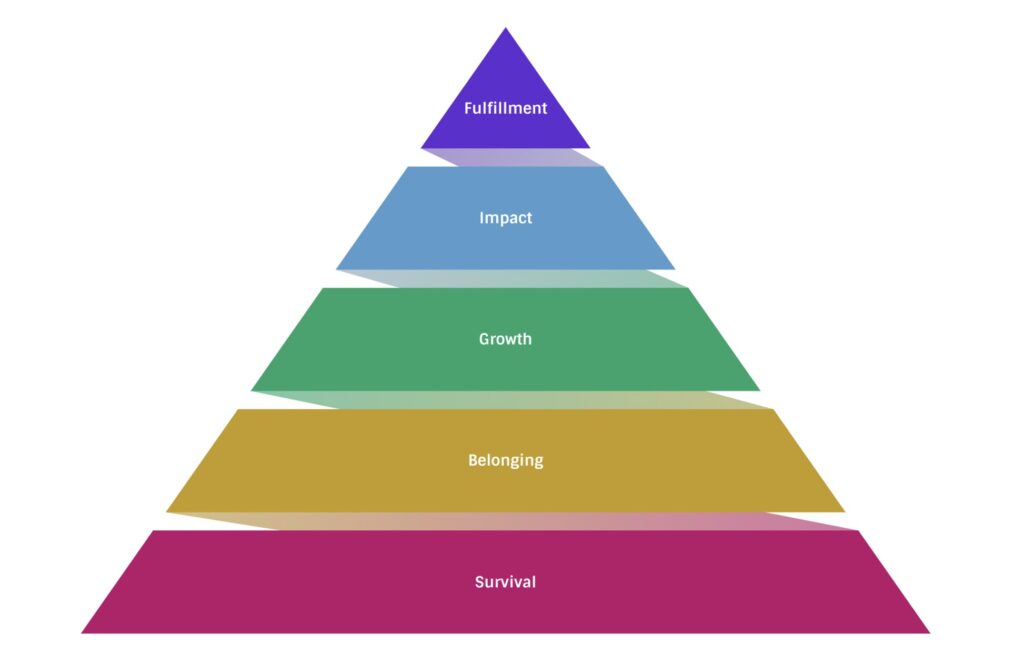
Older, tighter-knit communities understood this instinctively: you want people who worry about safety, people who chase growth, and people who hold the group together, all in the same room. Survival-minded members keep a team vigilant. Belonging-minded members keep it cohesive. Growth keeps it sharp, impact keeps it moving, fulfillment keeps it honest about why any of the moving matters.
What happens when one value dominates
Take away that diversity and a single value quietly warps the team's judgment. Too much Survival and growth stalls, because everything starts to look like a risk not worth taking. Too much Belonging and no one says the hard thing that needs saying. Too much Growth and the team never sits still long enough to consolidate a win. Too much Impact and the drive for status crowds out collaboration. Too much Fulfillment and the team gets so attached to meaning it stops shipping anything practical.
Balancing this is a genuine leadership skill — knowing when to lean into a value's strength and when to rein in its excess. It's why the best-designed organizational values sets draw from more than one category: something from belonging, something from growth, something from impact or fulfillment. Airbnb's stated values include "Be a Host," "Embrace the Adventure," and "Champion the Mission" — read them through our five pulls and you can see Belonging, Growth, and Fulfillment all represented, even though that's our lens on it rather than Airbnb's own labeling. LinkedIn's culture deck once balanced "Transformation" against "Integrity" and "Collaboration" — Fulfillment leaning against Impact and Belonging — though the company has since updated its stated values, a reminder that these things move over time. Dell mixes "Direct Relationships" (Belonging) with "Global Citizenship" (Fulfillment) and "Winning" (Impact). Atlassian holds "Open company, no bullshit" (Impact) alongside "Build with heart and balance" (Growth) and "Play, as a team" (Belonging). None picked one value and rode it. They built in tension on purpose — which is what lets a team move from surviving to thriving.
Calm is what makes the shift from survival to thriving possible
Calm isn't just a nicer way to work — it's a lever. A team under constant low-grade alarm defaults to its most defensive value, whatever that is for each person. A calm team can access its fuller range: belonging deepens, growth becomes safe to pursue, impact-driven people lead without leaving others behind, and fulfillment-seekers get room to contribute in a way that fits the work.
I think of a team working through a brutal deadline. The survival-oriented were fixated on the timeline slipping. The belonging-oriented were trying to keep the peace despite the pressure. The growth-oriented kept pitching new approaches. The impact-driven wanted bold targets. The fulfillment-driven were quietly worried the project was losing its point. Nobody was wrong. The leader's job wasn't to pick a side — it was to open a conversation where all five concerns could be said out loud, so the team could find a path that held caution and ambition, unity and momentum, purpose and practicality, all at once.
That's what good leadership looks like day to day: reassuring the people bracing for the worst while giving the growth-chasers room to run, then slowing the impact-and-growth crowd down long enough to let process catch up. Running a team well is a constant negotiation between innovation and chaos, process and bureaucracy, and it never fully resolves. That ongoing negotiation is the job.
A practical way to start: the Team Values Assessment
Knowing all this is one thing. Actually finding out what each person on your team values is another. That's what our Team Values Assessment is built for — a tool from Start With Values that gives leaders and teams a clear, specific picture of what's driving each person, rather than a vague sense of it.
It's not a personality quiz you take once and forget. Used well, it's the opening move in a longer conversation about individual and collective motivation. Participants come away with their own values profile, a picture of the group's shared values, a clearer sense of what each person specifically brings to the team, and a better feel for how that diversity adds up to something more resilient than any one value could on its own. The assessment is the diagnosis; the real work happens after, usually in a workshop or two with a skilled facilitator, where the gaps get named and trust gets rebuilt.
Values are the thing underneath everything else
Understanding your team's core values isn't a performance initiative dressed up in nicer language. It's closer to a long-term commitment — to a culture honest about what people actually care about, strong enough to hold real differences without fracturing.
Leaders who take this seriously tend to find something beyond individual insight: a kind of synergy that's hard to manufacture any other way. A team that understands its own values responds better to change, holds up better under pressure, and more often than not brings out more of what people are actually capable of.
There's a second payoff, too. Once you know what your people value individually, you can see where it overlaps with what your organization stands for, and where it doesn't. That overlap is where your real ambassadors live: the people who can carry each organizational value forward because it already resonates with something they hold personally. This is, in the end, how change actually takes hold. Not through a mandate from the top, but by starting with values.
Discover your own core values
The free, research-backed Values App assessment reveals your top five in about three minutes — no sign-up required.
Take the free assessment