


When you first meet someone, it's all excitement and anticipation — that giddy feeling of newness. You're both on your best behavior. And for a while, we happily shrug off the things that might otherwise annoy us, because we're already half-dreaming of the white picket fence, the three kids, and the color of the living room walls.
Then, little by little, our behaviors start to reveal what actually matters to us. And that's usually where the friction begins.
Here's what I've come to believe: a lot of that friction could be avoided — or at least softened — by doing one deceptively simple thing. Getting clear on each other's values. Not the surface preferences, but who each of you is at your core.
The friction is rarely about the dishes
Depending on how you count, something like 40% of first marriages in the United States end in divorce. The famous "50%" figure is closer to a myth than a fact, and the real rate has been falling for years — but it's still a lot of people. When researchers ask divorced couples what went wrong, the reasons that top the list are things like a lack of commitment, constant conflict, and infidelity (Scott et al., 2013) — and, again and again, some version of "we just grew apart."
Look underneath those words and you'll often find the same thing: values. Not a single blow-up, but a slow, unspoken drift between two people who wanted different things and never quite said so out loud.
The most reassuring research I know of here comes from John and Julie Gottman, who have studied thousands of couples over decades. Their finding: 69% of the problems a couple fights about are perpetual. They never get solved. They're rooted in fundamental differences in personality and lifestyle — which is another way of saying differences in values.
Sit with that for a second. More than two-thirds of your disagreements are, in a sense, permanent. And here's the kicker: happy couples and unhappy couples have roughly the same number of these unsolvable problems. What separates them isn't the absence of difference. It's whether they can keep a dialogue going about it — or whether the conversation goes quiet and the difference hardens into gridlock.
So the goal was never to find someone who shares all your values. That person doesn't exist. And honestly, they'd make for a fairly one-dimensional relationship.
Different values can be the whole point
I wrote a section about this in Start With Values, and I later spoke to Ann Sheu about it on the FLAME with Brad Hook podcast. Ann is a leadership coach, entrepreneur and mother of four, and the founder of Mpowered Journey, where she helps high-performing couples bring the clarity, alignment and intentionality from their businesses into their family life — building the communication, shared expectations and simple rhythms that reduce friction at home.
She said something that stuck with me: differing values aren't the end of the world. In fact, they can make for a richer, more well-rounded relationship. I wholeheartedly agree.
Think about an early human tribe. You needed different values. Some people valued safety and security — they protected what the group already had. Others valued adventure — they hunted and gathered over the next hill. A tribe of only home-guarders would have starved; a tribe of only wanderers would have been picked off. It was the mix that made them resilient.
Relationships work the same way. Ann described one of her most common patterns — the partner who's always packed and ready, married to the one who starts getting ready when it's time to leave. The trouble is that without doing any values work, we read those differences as character flaws. Her husband's love of adventure, she said, "is not just him going off and being selfish — it's part of his hardwiring." Once she understood that, the resentment drained out of it. She could see the value underneath the behavior.
Some value sets may genuinely be irreconcilable, and it's worth being honest when that's the case. But most couples, in my experience, can align — if they're willing to do two things. First, accept each other's differences. And second — this is the harder one — actually embrace them. Treat your partner's different values not as something to correct, but as something to learn from and grow alongside.
Alignment over agreement
One of Ann's phrases is worth tattooing somewhere visible: alignment over agreement. She and her husband run a company together, coach other couples for a living — and still argue. "We're aligned on the things that really matter," she told me, "but we still disagree about a lot of things." Disagreement isn't the alarm bell. Silence is. What corrodes a relationship is sweeping the difference under the rug until resentment quietly builds.
Two ideas of hers have stayed with me since.
The first is that you're on the same team. "If he loses and I win, we both lose," she said. "We either win together or we lose together." When she digs her heels in, it's almost always because she's forgotten that for a split second.
The second is a reframe of what "winning" a disagreement even means. "The winning criteria is not to win the argument," she said. "The winning criteria is: did your spouse feel seen, heard, understood, and safe?" If the answer is no, you didn't win — no matter how right you were. That one line quietly disarms most fights, because it changes what you're aiming at.
There are three of you in the room
Here's a framing I keep coming back to. In every relationship there are three entities: you, me, and the relationship itself.
We tend to pour all our attention into the first two — my needs, your needs — and forget the third. But the relationship is its own living thing, and it needs nurturing too. A shared reality. Its own set of values.
When you're aware of this, something shifts. Instead of gradually chipping away at each other — trying to file your partner down into someone who agrees with you — you start building something together, from the ground up. You get to keep being yourselves and create a third thing that belongs to both of you. Ann calls the long-range version of this a "decade dream": each partner writes their own ten-year vision, and then the two come together to write one for the family.
Three things to try
Reading about this is one thing. Here's how to actually do it.
1. Map your overlap. Separately, each of you gets clear on your own top values. If you've never done this, start here — or take the free assessment, which reveals your top five in about three minutes, no sign-up required. There's now a compare feature in the Values App that lets you line your values up next to someone else's — your partner's, say — and see exactly where you meet and where you differ:
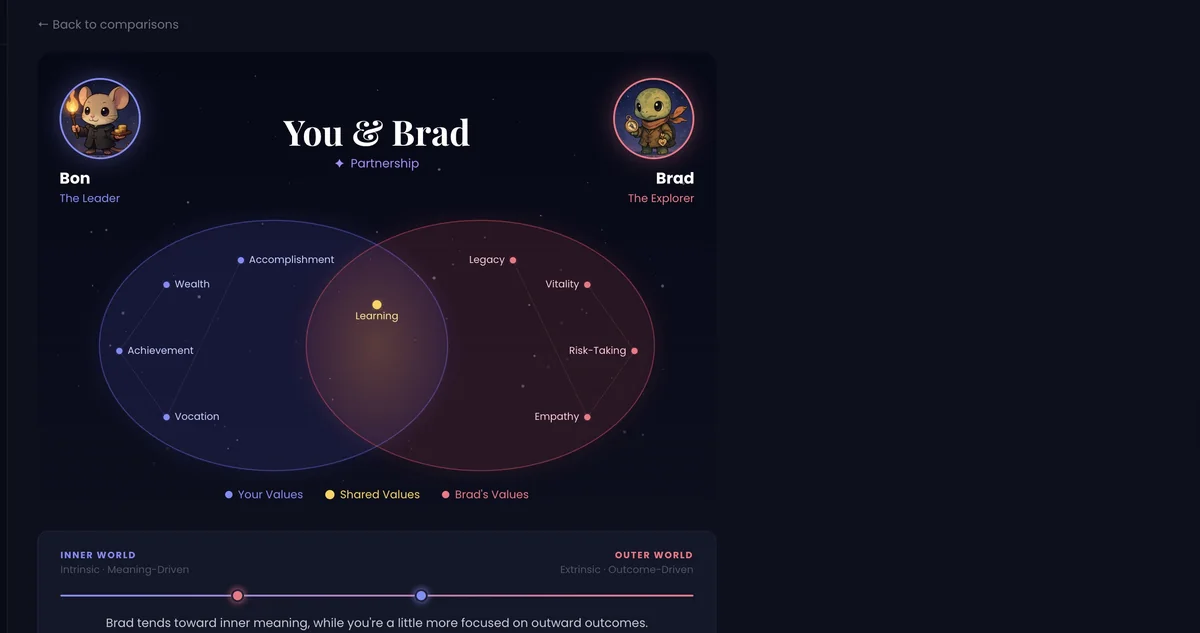
Then sort what you find into three piles:
- Shared — the values you both hold. This is your common ground. Name it out loud, because it's usually stronger than either of you realizes.
- Complementary — where you differ, but in a way that balances the relationship: your partner's love of adventure alongside your love of security. These are gifts, not threats.
- Friction points — the genuine tensions. You don't have to resolve these today. You just have to see them clearly and agree to keep talking about them, rather than letting them go silent.
2. Write the relationship's values — and a ten-year vision. Now tend to that third entity. Together, agree on a short set of values for the relationship — not yours, not theirs, but the ones you want your partnership to stand for. Three or four is plenty. Then sketch a shared vision for the next ten years: where you're headed, what you're building, what "a good life together" actually looks like. (If the difference between a value, a vision and a shared purpose feels blurry, this piece untangles them.)
3. Hold a weekly alignment meeting. This is the rhythm Ann swears by, and it's beautifully simple: once a week, you and your partner are the leadership team for your family, so you hold a leadership-team meeting. Check in on how the week went, glance at the week ahead, and talk through the decisions and tensions that would otherwise ambush you on a random Thursday morning. A standing, protected slot to raise things is what makes it safe to raise them — which is exactly the "seen, heard, understood and safe" she's after.
The real goal
Differences, handled well, don't weaken a relationship — they round it out. The couples who last aren't the ones who happened to match on everything. They're the ones who understood each other, respected what they found, and built a shared set of values big enough to hold both people.
Or, as Ann put it: be as intentional about your family as you are about your work — because your family is the most important team you'll ever lead.
You don't need to want all the same things. You need to know what each of you wants — and to care enough to keep the conversation going.
Discover your own core values
The free, research-backed Values App assessment reveals your top five in about three minutes — no sign-up required.
Take the free assessment