

Back in 1969, a scholar named Toffler made an observation that's stuck with me. He said values are "so inextricably woven into our language, thought and behavior patterns that they have fascinated philosophers for millennia. Yet they have proved so 'quick-silvery' and complex that, despite their decisive role in human motivation, we remain desperately ignorant of the laws that govern them."
Desperately ignorant. That's a strong phrase for an academic to use, and I think he was right to reach for it. Scholars have made real progress since the late sixties. But plenty stays murky. What follows is my attempt to walk through how our understanding of values has developed — from the ancient world to the modern boardroom — and where the gaps still are.
Values — definitions and perspectives
Rokeach gave us the definition most scholars still lean on. In his 1968 book Beliefs, attitudes, and values: A theory of organization and change, he described values as "abstract ideas, positive or negative, not tied to any specific object or situation, representing a person's belief about modes of conduct and ideal terminal modes." He adds that these values guide our actions and judgments across all sorts of specific situations — they're not one-off preferences, they're the underlying logic.
Why does any of this matter? Because the values people and organizations hold shape behavior and attitude — toward politics, toward money, toward how we treat each other. Theodorson and Theodorson put it nicely in A modern dictionary of sociology: "an attitude results from the application of a general value to concrete objects or situations." An attitude, in other words, is a value meeting real life.
Here's where it gets more interesting to me, though. Values differ from person to person even within the same society, because we're all socialized differently and internalize things differently. And yet the dominant values of a society tend to win out anyway — individuals get pressured, subtly or not, to conform. Schwartz, one of the leading scholars in this field, makes that case, and I find it hard to argue with.
Historical references to values
Humans have been preoccupied with values for about as long as we've been writing things down. Ancient philosophers poured real effort into debating and establishing ethical standards — and ethics, in its most basic form, covers both morality and values.
We have manuscripts from ancient Egypt and Sumer on this. The Sumerian Farmer's Instructions is a practical agricultural manual, but even it makes room for an ethical provision — telling farmers to leave gleanings for the poor. The Egyptian Instruction of Amenemope goes further, offering explicit moral instruction: generosity, honesty, humility. Two very different civilizations, the same underlying instinct.
Values in ancient China — an example from the East
Ancient Chinese ethics is largely Confucian, and Confucian ethics is usually understood as a form of virtue ethics — though some also treat it as a religion, or simply a way of governing life. It grew out of the teachings of Confucius (c. 551 BCE – c. 479 BCE), who was himself carrying forward values from the Xia (c. 2070 BCE–1600 BCE), Shang (c. 1600 BCE – c. 1046 BCE), and Zhou (c. 1046 BCE – c. 256 BCE) dynasties.
The Confucian code is humanistic, built on five constant virtues: integrity, knowledge, proper rite, righteousness or justice, and benevolence or humaneness. Those five are reached through righteousness, contingency, filial piety, loyalty, and a handful of other elements — important, but secondary to the main five.
Values in ancient Greece — an example from the West
The Greeks gave us 'Aretē' — living up to one's full potential, fulfilling the purpose of living. This was pitched in a purely philosophical register, which made it hard for the average person to actually grasp. Heraclitus (c. 535 BC – c. 475 BC), for instance, argued that in divine reality everything is just — injustice is only something we humans perceive.
Then there's Socrates (c. 470 – c. 399 BC), whose name is inseparable from the whole project of ethics and epistemology. He believed the best life pursued virtue, community, and friendship over material wealth. And his death backed it up — he accepted execution rather than escape, which historians read as him staying true to his own values, namely accepting the will of the community.
I'll add a caveat here, because it's an important one: some scholars think Socrates held views that don't sit comfortably with what we'd call universal principles today. In Plato's Republic — probably the best-known record of Socratic dialogue — Socrates argues democracy isn't viable at all. His alternative? Rule by philosophers, the only people he considered fit to govern.
Aristotle (384 BC–322 BC) built on Plato's work but shifted the frame. He valued goodness as embodied in happiness and prosperity, rather than 'good' as some absolute. Justice, prudence, temperance, courage — these were the virtues he emphasized.
Where the East meets the West
Confucian ethics traveled west and influenced a surprising number of European thinkers. Voltaire — no small figure himself — praised Confucius directly: "Confucius has no interest in falsehood; he did not pretend to be a prophet; he claimed no inspiration; he taught no new religion; he used no delusions; flattered not the emperor under whom he lived..."
It's become common to read Confucian ethics through a virtue-ethics lens. Some scholars think that's a fair and uncontroversial reading. Others push back, arguing it's really Confucian ethics squeezed into a western frame — and that the virtues in the Confucian tradition are more specific, maybe more constrained, than the western sense of the word.
Honestly, there isn't enough surviving literature from the classical period to settle every question here. But there is one point of agreement: both Greek and Confucian ethics were, at bottom, asking the same thing — what kind of person should I try to be?
Modern research into values
The field got a lot more formalized with Immanuel Kant, whose work turned ethics and values into something closer to a discipline.
Kantian ethics
Kant (1724–1804), the German philosopher, gave us what's now called Kantian Ethics, or Deontological Ethics. The core idea: an action is moral if the principle behind it lines up with moral law and comes from a sense of duty. Reason and intention determine morality — not outcome.
Duty sits at the center of his whole framework. Kant argues that goodwill is the only value that's unqualifiedly good, because every other value can, in the wrong hands, produce an immoral end.
He also proposes what's called the universality and law-of-nature formulation: true moral values can't depend on external conditions, including the desires or identity of whoever's doing the moral reasoning.
There's a genuinely useful test buried in here. Kant asks us to check our own maxims — the intentions behind an act — by asking: what if this became a universal law of nature? Would I still want it?
He goes further still: every moral action has to spring from a righteous maxim and be aimed at a proper end. And in Grounding for the Metaphysics of Morals, he lands on the line he's most remembered for — humanity should never be treated as a means to an end, only ever as the end itself.
Some of his conclusions are genuinely controversial. Take animal cruelty. Kant doesn't call it wrong because it violates the wellbeing or safety of the animal — he calls it wrong because it violates our own duty to ourselves, our duty to be more compassionate people.
Values as part of other disciplines
Values eventually spread out of philosophy and into other fields entirely. Business Administration is a big one — values get studied there at the individual, organizational, institutional, and national level.
Organizational values (or corporate values) are the set of values that shape an organization's long-term wellbeing, articulating the ethics behind its internal and external conduct. This usually gets communicated outward through a mission statement.
A mission statement — a declaration of the company's core purpose — tends to stay fixed over time, because it reflects the more constant human values underneath the operation. There's a nice echo of Kant here: the act gets judged by the intention behind it.
It's standard practice now for organizations to publish their mission, since stakeholders are more likely to align with a company whose stated values match their own.
The major modern theories
Schwartz is the name to know here. His 1992 paper, 'Universals in the Content and Structure of Values: Theoretical Advances and Empirical Tests in Twenty Countries,' gave values a rigorous structural description. He frames values as both an expression of, and a reason for, meeting basic human needs.
His theory identifies fifty-six values clustering into 10 motivationally distinct value types. Schwartz, together with Bilsky, offered his own definition of values in 1987 — "concepts or beliefs, which pertain to desirable end states or behaviors, transcend specific situations, guide selection or evaluation of behavior and events, and are ordered by relative importance" (Schwartz & Bilsky, 1987) — building on Rokeach's earlier 1973 definition of a value as "an enduring belief that a specific mode of conduct...is personally or socially preferable."
What makes Schwartz's work so influential is the evidence behind it. He found that 44 of the original 56 values held a consistent motivational meaning across at least three-quarters of the cultural samples he studied — enough, with a handful of exceptions, to support the value types as genuinely universal. That's a big claim, backed by a lot of legwork.
Schwartz also mapped the structure between values — how pursuing one value sits, compatibly or otherwise, alongside pursuing another. This turns out to be a substantial area of research on its own. Traditional values, for example, tend to sit comfortably with security values. A person can chase incompatible values over time, Schwartz argues — just not within a single act. His structural model became the reference point most scholars now use to map how values conflict or complement each other.
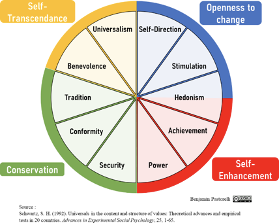
The circle above shows Schwartz's motivational continuum — the mutual compatibility and conflict among basic values. Values that are psychologically similar sit next to each other; values likely to pull behavior in conflicting directions sit across from each other, on opposite sides of the circle.
Values, on this account, are determinants of attitude and behavior. They transcend specific objects and situations and sit close to the center of human cognition — which is part of why there are relatively few of them.
Schwartz's theory has since been tested and cited in thousands of studies worldwide — the foundational 1992 paper alone has racked up more than 14,000 citations — including in representative national samples such as the European Social Survey, using instruments that weren't even built around his original framework. And the results keep confirming his central assumptions across cultures. That's a rare kind of durability for a social-science theory.
Organizational values
You can't really talk about organizational goals and vision without values coming up. That said, plenty of industries have pushed back against making the organization "value-centric" — worried it might crowd out the core objective of maximizing shareholder wealth, or replace hard regulation with a set of loosely defined values. Researchers in the field respond that this needn't be an either/or. Done right, values can actually set limits on possible violations and simplify decision-making.
Inside an organization, values strengthen or weaken depending on how many employees actually comply with them, and how much emphasis leadership puts on sustaining them. Put simply: organizational values can expire from low commitment. And certain fundamental values — the ones tied closely to human principle or to organizational identity — aren't really optional. They're default. Violate them and you'll meet resistance.
Identity-linked values are trickier still. On one hand, a clear moral position draws in outside parties who share it. On the other, it can harden into an 'us versus them' mentality.
All of which points toward organizational culture — the medium through which values actually get communicated, reinforced, and changed.
Schein and Schein, in Organizational Culture and Leadership, define organizational culture as "accumulated learning [that forms] a pattern or system of beliefs, values and behavioral norms that come to be taken for granted as basic assumptions and eventually drop out of awareness." That last phrase always strikes me — values that drop out of awareness are the ones running the show.
Researchers have found that even where individuals hold specific value preferences, organizations supply a powerful normative context — one that ends up mainstreaming whichever values get room to operate.
A number of organizational culture models try to capture this. Some assume that any honest account of culture has to include its hidden parts. Schein and Schein's 2017 model falls in this camp, as does Rousseau's 1990 layered model, which distinguishes outer, more visible layers of culture — artifacts and behavioral patterns — from inner, less visible layers, namely values and the assumptions underneath them. The Iceberg model, developed by Herman, draws a similar line — formal, overt aspects like technology, structure, policy, and systems above the waterline; informal, covert aspects like perception, values, attitude, and belief below it.
Other models come from different theoretical roots entirely. Deal and Kennedy built theirs around risk and feedback. Harrison and Handy developed a typology around four organizational cultures: power, role, task, and person. Denison and Mishra look at top-down vision versus bottom-up involvement, and weigh consistency against adaptability. Cameron and Quinn's Value Framework Model sits flexibility-and-discretion against stability-and-control, and internal focus-and-integration against external focus-and-differentiation.
Any organization that wants to genuinely examine its own values — and those of its people — needs to do it with real attention to its culture. Otherwise the exercise is mostly cosmetic.
Take away
Values have shaped human progress for centuries now. Philosophers, institutions, scholars, businesses — they've all wrestled with the same underlying question, just from different angles.
If one of the philosophers we've discussed here walked into the room today, I suspect they'd remind us that values are only meaningful in application — that living by a value should be an expression of a genuine desire toward virtue, not a slogan.
Here's my honest read on the present moment: value-based language in today's markets often doesn't tell you which values an organization actually holds. It tells you which values are currently profitable to display. Pragmatism, some would say — not values at all.
Both individuals and organizations could stand to hold more values, and hold them with more sensitivity — genuinely weighing things that don't show up on a balance sheet but still shape a company's standing in the world.
There's a cost to this, though, and it's worth being honest about it. Committing to more values means processing more information. That's a real burden when most people already feel stretched thin on time and attention just keeping the core operation running.
But it doesn't have to be expensive. Organizations can build sensitivity simply by having fuller, more honest conversations with the people around them — employees, customers, clients — and beyond that, environmentalists, neighbors, anyone who notices what doesn't make it into the meeting minutes or the balance sheet.
The case for values-aligned organizations has been made well, and often, across independent studies. Where I land is this: the future belongs to people who can gather around shared values while still respecting real difference in values. In a world this complex and this uncertain, that balance might be the whole game.
References:
Kant, I., 1785. Grounding For The Metaphysics Of Moral. Indianapolis: Hackett Pub. Co.
Rokeach, M. (1968). Beliefs, attitudes and values: A theory of organization and change. San Francisco, CA: Jossey‐Bass.
Schein, E. and Schein, P. (2017). Organizational Culture and Leadership. 5th ed. New Jersey: John Wiley and Sons.
Schwartz, S., 1992. Universals in the Content and Structure of Values: Theoretical Advances and Empirical Tests in Twenty Countries. Advances in Experimental Social Psychology, 25(1), pp.1–65.
Theodorson, G. and Theodorson, A., 1969. A Modern Dictionary Of Sociology. New York, NY: Crowell.
Toffler, A. (1969). Value Impact Forecaster—A Profession of the Future. In: K. Baier and N. Rescher, eds., Values and the Future: The Impact of Technological Change on American Values. New York: The Free Press.
Discover your own core values
The free, research-backed Values App assessment reveals your top five in about three minutes — no sign-up required.
Take the free assessment