
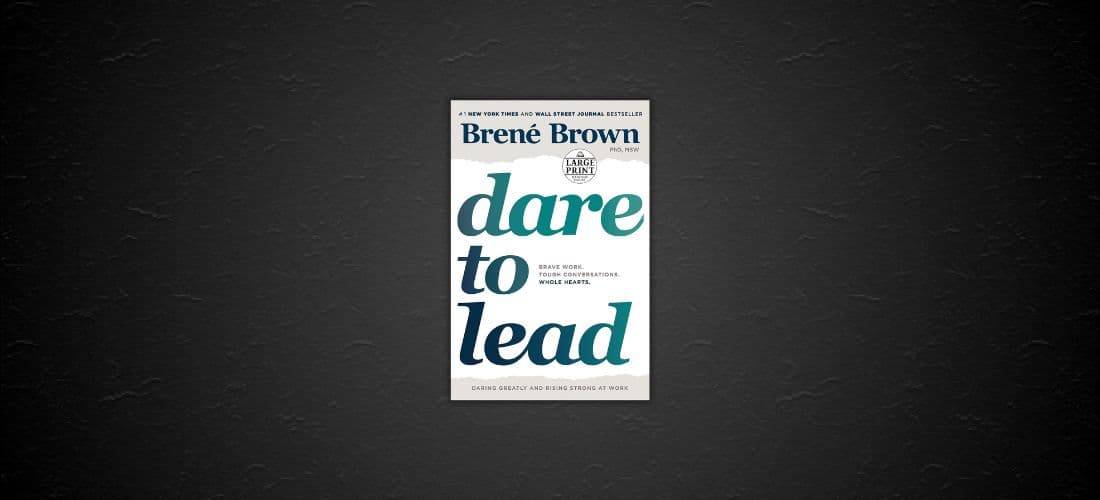

Most leadership books ask you to build armour. This one asks you to take it off.
That's the whole provocation of "Dare to Lead", and it's a harder sell than it sounds. Brené Brown spent decades studying shame, courage, and connection before she turned her attention to organizations, and what she found there unsettled a lot of tidy assumptions about what leadership is supposed to look like. We tend to picture the leader as the person who has it together, who doesn't flinch, who has an answer ready before the question is finished. Brown's research says something close to the opposite: the leaders people actually trust are the ones willing to say "I don't know" out loud, in front of the team, and mean it.
Vulnerability isn't the soft part of leadership
Brown's central move is to redefine vulnerability away from weakness and toward something closer to exposure without guarantee of outcome. You raise the hard issue in the meeting not knowing how it'll land. You give feedback that might damage the relationship. You admit the strategy isn't working before anyone else says it. None of that is comfortable. All of it is necessary if a team is going to operate with any honesty at all.
What I find persuasive here is that Brown doesn't romanticise this. She's not saying vulnerability feels good or that openness is its own reward. She's saying it's one of the central findings of her research: that the level of collective courage inside an organization is the best predictor of whether it can succeed, grow leaders, and actually fulfill its mission. Armoured leadership — the kind that performs certainty and punishes doubt — quietly starves a culture of the very information it needs to improve. People stop bringing you bad news. They stop admitting mistakes early, when they're cheap to fix. The team gets quieter, and mistake it for calm.
The values still have to be lived, not laminated
Brown is unsparing about something a lot of leadership programs skip past: having values on a wall means almost nothing. What matters is whether you can name the specific, observable behaviors that living those values looks like under pressure — and whether you're willing to hold yourself to the same standard you'd hold a direct report to. Courage, in her framing, isn't a personality trait some people have and others don't. It's a set of skills. Which means it can be taught, practiced, and — this is the part leaders often resist — it can be gotten wrong in ways you have to own out loud.
That's where the book earns its subtitle. Brave work and tough conversations aren't separate skills you deploy occasionally; they're the daily texture of leading with any integrity. Avoiding the hard conversation doesn't make a team more harmonious. It just moves the cost downstream, usually to a moment when it's more expensive and more personal.
What actually changes if you take this seriously
- Vulnerability stops being something you tolerate in others and becomes something you practice yourself, first, before you ask it of anyone else.
- Clarity about your values only counts once you've had to defend them under pressure — a value untested by a hard decision is just a preference.
- The conversations you're avoiding right now are usually the exact ones that would move things forward, which is precisely why they're uncomfortable.
There's a generosity to Brown's argument that I appreciate: she isn't asking leaders to be softer for its own sake. She's asking them to be braver, and pointing out — with the receipts of her research to back it — that bravery and softness were never actually opposites. "Dare to Lead" leaves you with a fairly specific challenge: stop leading from behind the desk, hands folded, waiting to be impressed. Get into the arena. Keep your shield down. See what happens when your team realizes you mean it.
About the author
Dr. Brené Brown is a research professor at the University of Houston, where she holds the Huffington Foundation Endowed Chair at the Graduate College of Social Work. She also holds a professorship in management at the University of Texas at Austin McCombs School of Business, where she has been listed as visiting professor and, more recently, Professor of Practice in Management.
Brené has spent the past two decades studying courage, vulnerability, shame, and empathy. She is the author of six #1 New York Times best sellers and is the host of two award-winning Spotify podcasts, Unlocking Us and Dare to Lead.
Brené's books have been translated into dozens of languages worldwide, and her titles include Atlas of the Heart, Dare to Lead, Braving the Wilderness, Rising Strong, Daring Greatly, and The Gifts of Imperfection. With Tarana Burke, she co-edited the best-selling anthology You Are Your Best Thing: Vulnerability, Shame Resilience, and the Black Experience.
Brené's TED talk on the Power of Vulnerability is one of the most-viewed TED talks in the world, with over 70 million views. Her 2019 special, The Call to Courage, was one of the first filmed lectures by an academic researcher to stream on Netflix, and in March 2022, she launched a new show on HBO Max that focuses on her latest book, Atlas of the Heart.
Brené spends most of her time working in organizations around the world, helping develop braver leaders and more-courageous cultures. She lives in Houston, Texas, with her husband, Steve. They have two children, Ellen and Charlie, and a weird Bichon named Lucy.
Leadership is not about titles, status, and wielding power. A leader is anyone who takes responsibility for recognizing the potential in people and ideas and has the courage to develop that potential
Discover your own core values
The free, research-backed Values App assessment reveals your top five in about three minutes — no sign-up required.
Take the free assessment