

History leaves us more than dates and achievements. It leaves us a record of what people actually valued — what they were willing to sacrifice for, argue for, or die for. I find that record more useful than almost anything else I read, because values are the part of a life you can actually borrow.
Here are ten people whose impact on the world is hard to overstate, and the values I think explain why.
Mahatma Gandhi
The best way to find yourself is to lose yourself in the service of others.
This line has long been associated with Gandhi, and it captures his philosophy of service well — though, for what it's worth, no one has ever traced it to a specific speech or piece of his writing.
- Non-violence (Ahimsa): At the center of Gandhi's thinking was the conviction that non-violence is the most powerful weapon available to anyone. He resisted oppression without ever resorting to violence himself.
- Truth (Satya): Gandhi believed that truth is God. His life was a constant pursuit of it, in his personal conduct and in his fight for India's independence alike.
- Simplicity: He lived simply — basic clothing, a vegetarian diet, few possessions. He believed in reducing his needs rather than expanding them.
Marie Curie
Nothing in life is to be feared, it is only to be understood. Now is the time to understand more, so that we may fear less.
- Perseverance: Curie faced real obstacles, including outright gender bias in the scientific community of her day, and stayed with her research anyway. She went on to win two Nobel Prizes in two different scientific fields — Physics in 1903, Chemistry in 1911 — and to this day, she's still the only person who's managed that.
- Intellectual curiosity: She kept pushing into the unknown, and that drive is what produced her groundbreaking work on radioactivity.
- Dedication: She worked long hours in the lab for years. Whatever else you say about her, the discipline was relentless.
Nelson Mandela
Our greatest glory is not in never falling, but in rising every time we fall.
Mandela was fond of quoting this line publicly — it's actually a centuries-old adage traceable to the 18th-century writer Oliver Goldsmith, not something he coined himself, but he invoked it often enough that it's become inseparable from him.
- Reconciliation: After 27 years in prison, Mandela came out without bitterness and pushed for reconciliation between South Africa's divided racial groups. I don't think that's a small thing — most people would have come out angrier, not more generous.
- Leadership: He led with dignity, humility, and a real sense of responsibility, and it showed in how peacefully South Africa moved from apartheid to democracy.
- Selflessness: He put the country ahead of himself, stepping away after one presidential term to focus on community service rather than clinging to power.
Leonardo da Vinci
Learning never exhausts the mind.
This is one of the most widely quoted lines attributed to da Vinci, though I should say it doesn't turn up in any of his surviving notebooks — it's popular enough, and true enough to how he lived, that it's stuck to his name regardless.
- A multidisciplinary approach: Da Vinci saw art, science, and nature as connected rather than separate fields. His interests ran from anatomy to flight, and that range says a lot about how he saw learning itself.
- Innovation: He was never satisfied with what was already known. He kept pushing past it, which is why so many of his inventions and ideas were centuries ahead of their time.
- Observation: He trusted close, patient observation of nature and his surroundings as the real route to understanding the world — not theory for its own sake.
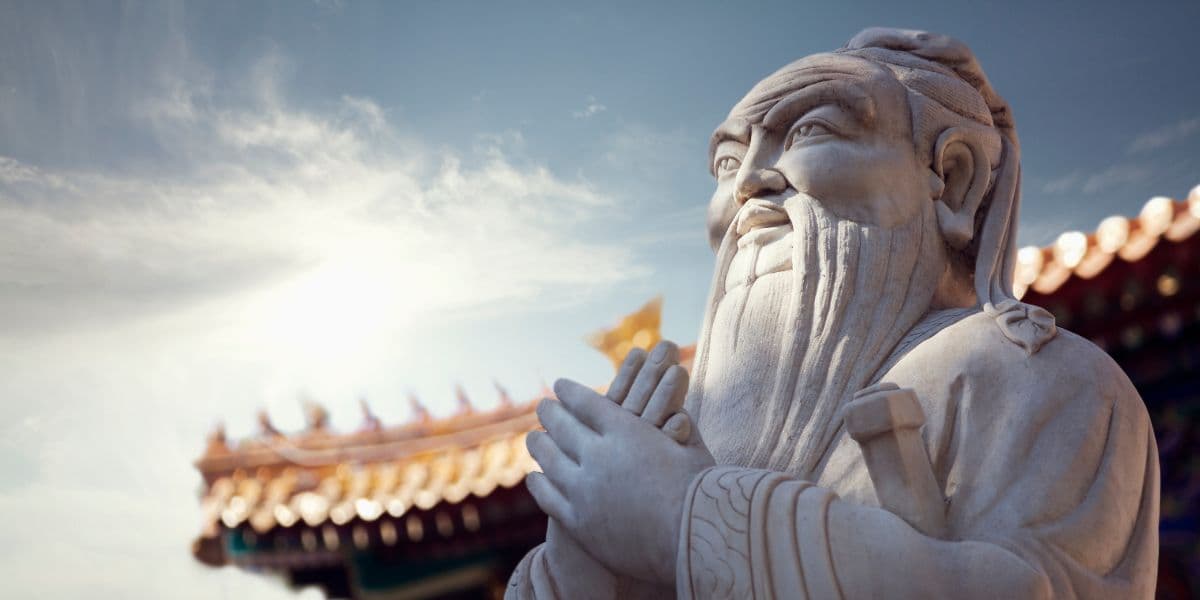
Confucius
It does not matter how slowly you go as long as you do not stop.
This one is everywhere online, credited to Confucius, but it doesn't actually appear anywhere in the Analects — it's most likely a later proverb that got attached to his name. Even so, it echoes something genuinely his: the emphasis on steady, lifelong self-cultivation over quick results.
- Moral integrity: Confucius put virtue and personal integrity at the center of daily life, not as an abstract ideal but as a practical discipline.
- Respect for tradition: He was open to new ideas, but he still believed in learning from the wisdom of the past rather than discarding it.
- Social harmony: He believed a just, harmonious society follows when individuals act with righteousness and propriety — the collective good built from personal conduct.
Martin Luther King Jr.
The time is always right to do what is right.
- Non-violence: Drawing directly on Gandhi, King believed non-violent protest was the most effective route to social and political change. The line from one to the other is direct and worth sitting with.
- Equality: He fought for the plain belief that all people are created equal, regardless of race or color.
- Service: He kept returning to the importance of serving others, and to the power of love and unity as forces that actually move history.
Mother Teresa
Not all of us can do great things. But we can do small things with great love.
This is one of the most quoted lines attributed to her, and it fits everything we know of her philosophy — though, as with a lot of these, the exact phrasing can't be traced to any particular speech or piece of writing.
- Compassion: Her life was marked by consistent compassion for the sick, the poor, and the dying — not occasional, but constant.
- Selflessness: She gave her life to serving others, especially those most vulnerable and marginalized.
- Faith: Her work was rooted in her Christian faith. For her, serving the needy was serving God directly, not a separate activity.
Albert Einstein
Life is like riding a bicycle. To keep your balance, you must keep moving.
- Curiosity: Einstein was driven by a deep curiosity about the universe, and that curiosity is what produced his groundbreaking theories.
- Creativity: His gift for thinking outside conventional frames, for picturing concepts in genuinely new ways, is what set him apart from equally trained peers.
- Pacifism and globalism: He started as a pacifist, and his views evolved, particularly after the Second World War. Later in life he became a strong advocate for internationalism and global collaboration.
Rosa Parks
To bring about change, one must not be afraid to take the first step, or else it will not be done. I believe that the only failure is failing to try.
That's how Rosa Parks actually put it, in her 1996 book Dear Mrs. Parks.
- Courage: Her simple act of defiance on a bus took real courage, and it made her a lasting symbol of resistance to racial segregation.
- Dignity: Even under real adversity, she carried herself with grace and dignity.
- Persistence: She stayed committed to civil rights and justice for the rest of her life, long after the moment that made her famous.
William Shakespeare
It is not in the stars to hold our destiny but in ourselves.
- Human insight: Shakespeare's work goes deep into the human psyche, covering an enormous range of emotion and experience. Four centuries on, it still reads as accurate.
- Innovation: He bent language to his will — coining words and phrases still in use today — and reshaped what drama and poetry could do.
- Universality: His themes hold up across ages and cultures, which is a large part of why he's still read and staged everywhere.
Looking back across these ten lives, I keep landing on the same conclusion: it's the values that hold up, not just the achievements. Socrates' commitment to questioning things, Gandhi's non-violence, King's dedication to equality — in each case the belief came first, and the impact followed from it. Perseverance, integrity, courage, compassion: these aren't decorative traits sitting beside the accomplishments. In my experience, they're the actual mechanism. Talent and timing matter, sure, but it's the values that provide the direction. That part, at least, is available to the rest of us too.
Discover your own core values
The free, research-backed Values App assessment reveals your top five in about three minutes — no sign-up required.
Take the free assessment