
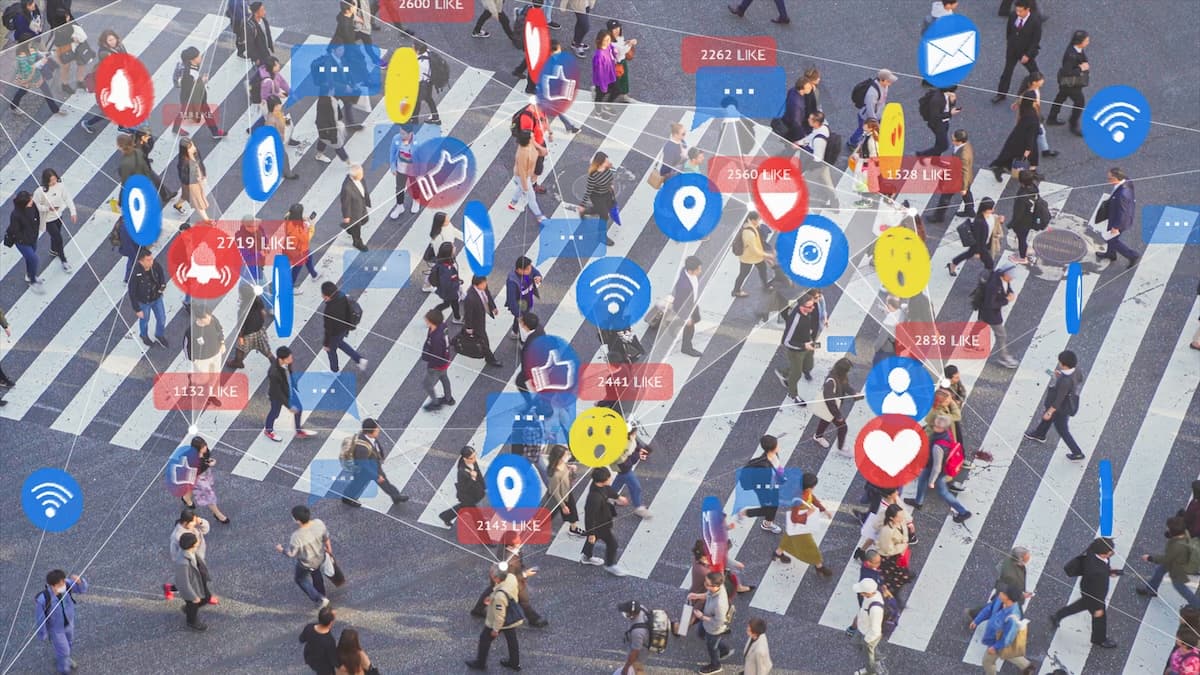

Social media is probably the single most powerful force shaping our lives right now. It shapes what we believe, how we engage with the world, and the opinions we form on politics, climate change, even gender ideology. Quietly, and mostly without our noticing.
Here's the strange part. The thing that once connected us now divides us. It drives polarization, it exaggerates extreme views, and most of us can feel this happening even as we keep scrolling. Why? And, more usefully, what do we do about it?
Let me walk through how social media has shifted our values, exaggerated our divisions, and — I think — how we start reconnecting with each other by leaning back into common sense and shared humanity.
The polarizing effect of social media
Social media thrives on engagement. Platforms like Facebook, X, and Instagram are built, quite deliberately, to keep us scrolling. The more time we spend there, the more data they gather, and the more targeted the content becomes. Here's the catch: the most engaging content is usually the most extreme.
Algorithms prioritize whatever gets a strong reaction. And what gets people to react? Emotionally charged, often polarizing content. Posts about politics, climate change, and other divisive topics reliably pull more likes, shares, comments. So a feedback loop forms: the more extreme the content, the more engagement it earns. People get pushed into echo chambers, seeing mostly what already confirms what they think.
Live inside that long enough and you start to believe everyone who disagrees with you is your opponent. It exaggerates the differences between us. It makes common ground harder to find, even when it's right there.
Algorithmic bias and the impact on values
One reason social media fuels polarization is algorithmic bias. Algorithms are built to show us content that matches our own behavior — what we've clicked on, lingered over, reacted to. Over time this builds a tailored experience. Designed to keep us coming back. There's a cost to that.
By constantly feeding us content that confirms what we already believe, social media narrows our exposure to any other view. That reinforces our biases, sure, but it also does something sneakier: it convinces us the world is more polarized than it actually is. On politics, on climate change, the extremes dominate the feed, and it starts to feel like there's no middle ground left standing.
That's when we lose sight of shared values. Instead of seeking understanding, people dig in. The whole orientation shifts — from connection to division.
The effects on beliefs and the rise of limiting perspectives
The more we engage with extreme content, the more it shapes what we believe. People can become so attached to one side of an issue that they see the other side as simply, fundamentally wrong. That's binary thinking, and it strips out nuance. It shuts down the conversation before it starts.
Take climate change. Most people agree it matters. And yet social media keeps pushing us toward extreme narratives — you're either an alarmist or a denier. No room, apparently, for someone who believes in climate action and also holds the complexity of the issue. That rigidity is what stalls progress.
Same pattern with politics, with gender ideology. Social media rewards reducing a complicated issue down to a simple, polarized position. That doesn't just limit the discussion — it limits us, as people. When we close ourselves off from other perspectives, we stop growing.
Who benefits from division?
Worth asking directly: who benefits from all this division? I'm not talking conspiracy theories here — just the old, well-documented tactic of divide and conquer. History is full of leaders who exploited division to gain control. One of the most notorious examples is Adolf Hitler, who rose to power by dividing Germany along racial and societal lines. By amplifying fear and hatred, he radicalized the population, with devastating consequences for millions. Fracturing the nation is precisely what let him seize control and enforce authoritarian rule.
When a population is divided, it becomes far easier for an authoritarian leader to manipulate fear and suppress opposition. Keep going down the road of extreme polarization, and we risk losing our capacity for civil discourse altogether — and opening a door we'd rather stayed shut.
History has shown, more than once, that division left unchecked leads to real suffering.
Rewriting limiting beliefs
So how do we start rewriting these limiting beliefs? Awareness comes first. We have to recognize that social media isn't a mirror held up to reality — it's a carefully curated environment, engineered to keep us engaged. Once that lands, we can start questioning what we're actually looking at.
Ask yourself: are my beliefs based on genuine experience, or have they been shaped by whatever content I happen to engage with? Am I being fed material that just reinforces my existing views, or am I actually open to other perspectives?
Sit with those questions honestly and you start to activate common sense again — you start seeing the bigger picture. This isn't about changing our values. It's about expanding our understanding of them.
Finding shared values in a divided world
Here's the thing social media won't tell you: we share more common ground than it looks like. Most people want the same basic things — security, fairness, a better future for the people they love. It's when we forget that, that the divisions grow deeper.
Finding common ground starts with a shift in mindset. Instead of fixating on what divides us, look for what unites us. Start from empathy and respect, and even the hard conversations get more productive. Seek out shared values, and you start to drain some of the polarization social media keeps feeding us.
Reconnecting with people, not platforms
Social media pulls us apart. Human connection is what brings us back. The best antidote to polarization, in my view, is reconnecting with people in real life. A few simple places to start.
1. Spend time face-to-face
Real conversations happen in person. Face-to-face, it's much easier to see each other as human beings rather than avatars standing in for one side of an issue. Make time for it — with family, friends, colleagues.
2. Listen to understand
Don't listen just to respond. Listen to understand. Approach a conversation with empathy and you start to see the complexity in each person's perspective. That builds bridges. The other way builds walls.
3. Limit social media exposure
Take breaks. Reducing your exposure to the constant stream of extreme content helps you reset, gain some perspective back. Even a digital detox of a few hours a day can make a real difference.
4. Engage in civil dialogue
Seek out — or create — spaces where civil conversation is actually possible. In your community or online, look for places where open dialogue is welcomed without pressure to pick a side.
5. Practice empathy
Go into conversations aiming to understand, not to convert. Everyone's beliefs were shaped by their own experience. Empathy is what lets us connect anyway, even across real disagreement.
The path forward
Social media has played a real part in shaping our values and beliefs, often pushing us toward more extreme versions of them. That doesn't mean we're stuck divided. By activating common sense, questioning what we consume, and returning to shared values, we can rewrite the narrative.
It's time to reconnect — with ourselves, and with each other. Human connection, not algorithms, should be what guides our beliefs and how we treat one another. Seek common ground. Listen with empathy. Cut back on the platforms. Do that, and a more united future starts to feel possible.
The world is complex. So are we. Let's not let social media decide who we are or how we connect. That power was always ours.
Discover your own core values
The free, research-backed Values App assessment reveals your top five in about three minutes — no sign-up required.
Take the free assessment