

Every relationship has three parts. There's you, there's your partner, and there's the relationship itself. Each one needs attention in order to flourish, and each one has its own values. Most couples have never talked about any of the three.
So have you ever considered what matters most to your girlfriend, boyfriend, partner or spouse?
What are relationship values?
Relationship values are the things that matter most to the two of you as a couple, and they guide how you spend your time, how you make decisions and how you treat each other. They sit alongside your own personal values and do not replace them. We have our own needs, and the relationship has its own needs too.
Many couples know Gary Chapman's idea of love languages, the ways we each like to give and receive love. Values sit one level further back, at why those things matter to us in the first place.
Why don't couples notice their different values at the start?
When we find someone attractive, what we usually like is the way that they make us feel. At the start of a relationship they're just perfect, and even the things that might normally annoy us, we're happy to overlook because there's this spark of possibility. In those first months the brain's reward system is working overtime. Dopamine keeps us wanting more, oxytocin helps us bond, and brain scans of people in love show the areas we use to judge others critically going quieter.
We're also on our best behavior. I might not reveal my jealousy or my messiness. When the person comes to your house, you tidy up.
Here's an example. A new couple meet and discover a shared value of adventure, so they travel the world and invest all of their time and money in new experiences, and it's a joyful, wonderful time for them. But when they return home and start to contemplate the next steps in their life, behaviors emerge that are unexpected, maybe even shocking, to the other partner. Now that they're renting a flat in the city, one of them realizes that a nine-to-five job is making them miserable, and wants to create a startup. The other wants a family. It's a shock to discover that one of them values freedom and autonomy, and the other values stability and family.
One partner feels betrayed. Didn't we both want freedom? Isn't that the principle upon which this relationship began? In fact, it wasn't freedom. It was adventure.
Why look at values, and not just behavior?
So much of the time, when we're unhappy with someone, we target the behavior. We focus on what they did or what they said without understanding why. It's one layer back that we get to our core values, because our values shape a lot of what we do.
Researchers who study couples have found this for more than thirty years: partners who explain each other's behavior in kinder terms are happier together on average. When we don't know why someone does something, the brain fills the gap with its own story, and when we're tired or worried that story is rarely kind. Knowing each other's values gives it a better one.
If one person values Learning and the other values Vitality, you now have clarity on why one would rather spend Saturday reading books and the other would rather spend it hiking through forests. And there might be a middle ground where you hike for some of the day and spend the rest of it learning.
How do you find your own values first?
The first thing is for each partner to get clear on their own values. That's what the Values App is for. You identify your top five from a list of 48, and then you create a hierarchy with the real focus on your top three. I believe that having three clearly defined core values makes decision-making easier. As a couple, though, knowing the full five is useful because it provides more opportunity for overlap.
You can take the free Values Assessment here.
What if you and your partner share none of your values?
Don't be alarmed if you don't share any. In our data from more than 7,000 adults, nine in ten have a top five that nobody else has. When we paired people at random, two strangers and not real couples, more than a third shared none of their five values, and only about one in five shared two or more.
Different values are not a verdict on a relationship. A study that pooled data from more than 11,000 couples found that how people felt about the relationship itself, such as feeling appreciated and feeling that their partner was committed, predicted how happy they were much better than anything about either person on their own.
You might also overlap one level up. The four categories of the values pyramid are Belonging, Growth, Impact and Fulfillment. One partner might value Family and the other Love, and those two meet in belonging. Two different values can also meet in a word of your own. One of you might value Vitality and the other Nature, and those two meet in movement.
And if one person's values cluster around Belonging and the other's cluster around Impact, that's perfectly fine. One of you may focus on the home and the family while the other is out there building, and if this works for both partners, that can be a fantastic blueprint. Knowing makes it easier.
How do you write a values statement as a couple?
Once you're clear on your own values and where they overlap, you can ask a bigger question. Which three values belong to the relationship itself?
Go back to our travelers. Their individual values are freedom, adventure and kindness for one, and stability, adventure and family for the other. Adventure stays on the list, because adventure doesn't require a plane trip. It can be as simple as a weekly excursion. Instead of freedom against stability, they settle on respect. And the third value is belonging, because kindness is relational, family is relational, and they realize that they both want a sense of home. That sense of home comes from the relationship itself.
Then we craft behaviors to bring the values to life, because values without behaviors are ideas. They're words on walls. If we value kindness, we go and visit Granny, even though we might have more fun on that camping trip. If we value creativity, we carve out every Sunday afternoon as creative time, and we don't leave it to chance.
We will live in our relationship just as we will live in a house. You wouldn't build a house and leave the interior to chance, would you? Your shared values are the foundations. They help you say yes and no, and they remove a lot of ambiguity.
Relationships, just like individuals, do change, so come back to your statement and update it.
How can values help when you argue?
Not every fight is about values. Some are about a long day and a short night, and research on couples finds that stress at work and a poor night's sleep both spill into how we treat each other at home. But when the same argument keeps coming back, it's worth asking which value sits underneath it.
Say one person is working late all the time, and the other feels neglected and starts worrying. Those worries can blow up. Now look to their values. Status is one of their core values, and so they're putting in the time. That opens up a much more empathetic conversation and the chance to ask, "Is this just a season, or is this something I need to accept?"
We move from accusations to clarity. There is a reason why someone does what they do, and a value is a good place to start looking. I wrote more about this in When You and Your Partner Have Different Values.
Find your values together
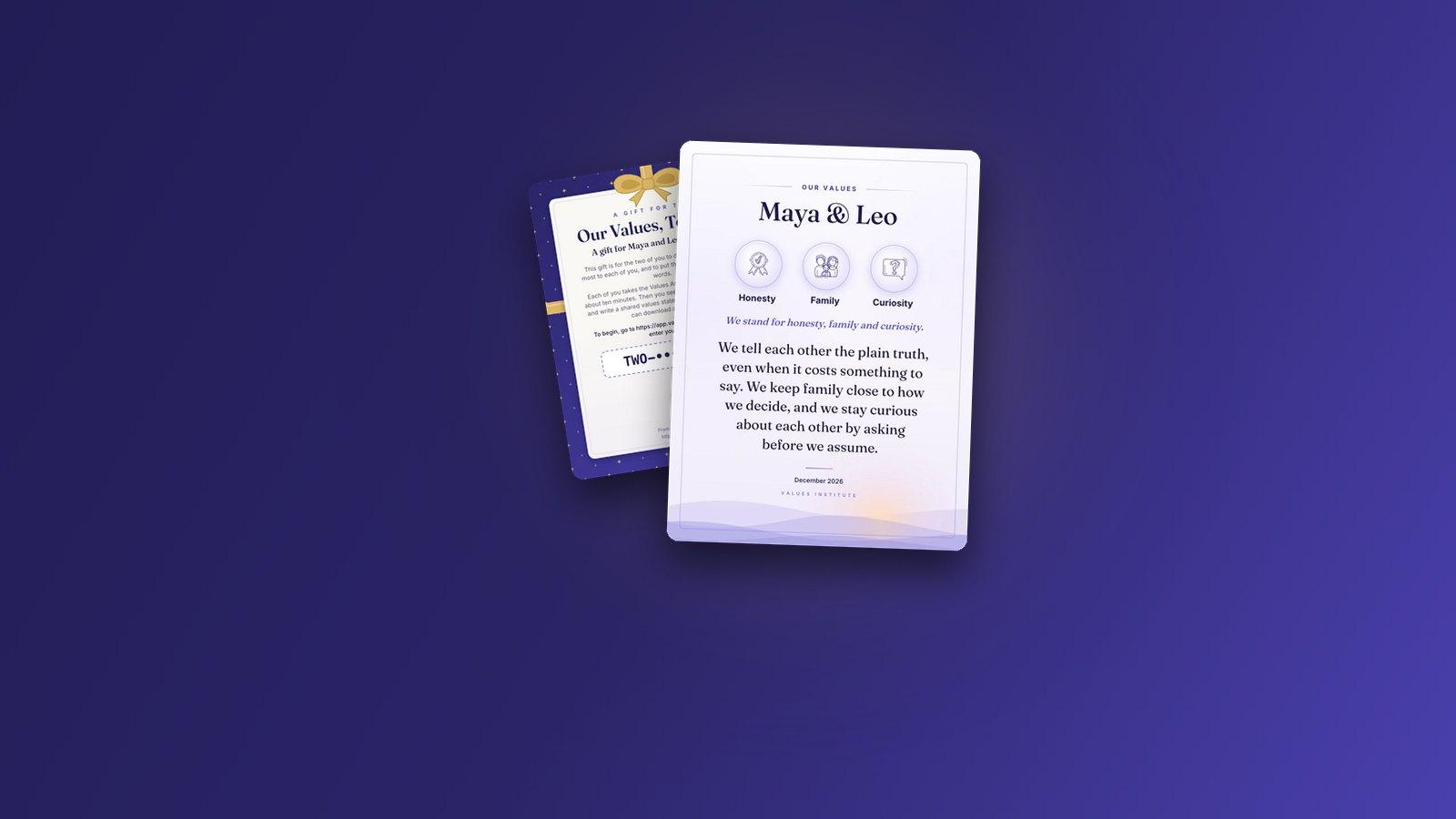
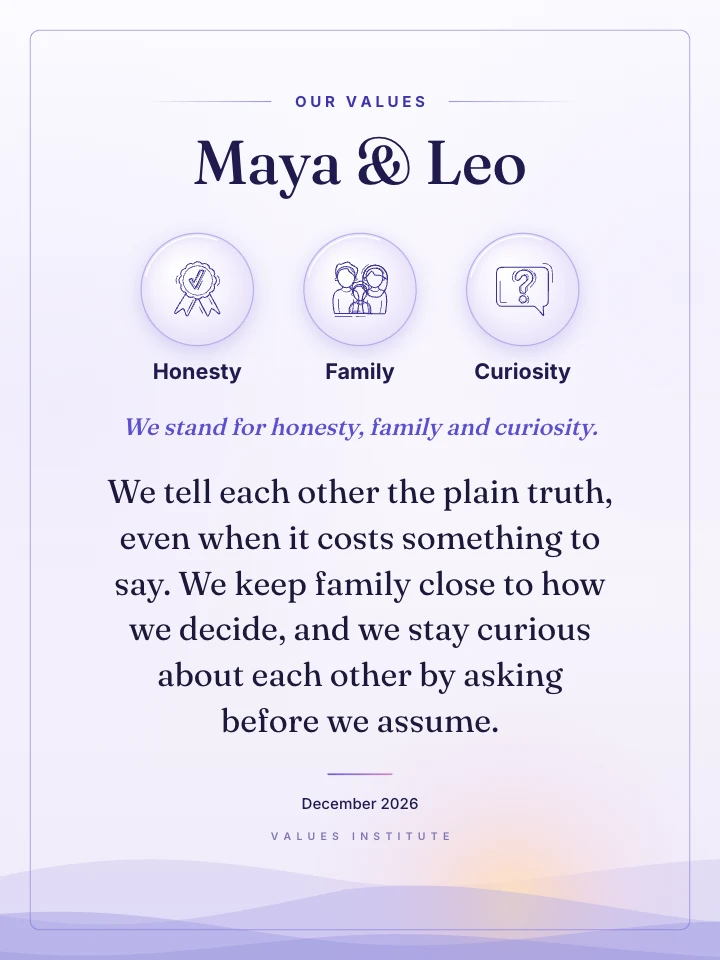
Our Values, Together is for two people. Each of you takes the Values Assessment, which takes about ten minutes. Once both of you have finished, and only if both agree, you see your values side by side. The app drafts a short shared values statement, you change it together until both of you are happy, and you download it as a poster.
Questions couples ask
What are examples of relationship values?
Among the 48 values in the Values Assessment, the ones people choose most are Family, Love, Peace, Vitality and Friendship. Your three as a couple will be your own.
Do couples need to have the same values?
No. Most people's top five values are unlike anyone else's. What matters more is that you each know the other's values and agree on a few that belong to the relationship.
How many shared values should a couple have?
I suggest three for the relationship itself, because three is few enough to remember and to act on.
Can relationship values change?
Yes. Different values become more or less important over the seasons of our lives, so read your statement again each year.
Discover your own core values
The free, research-backed Values App assessment reveals your top five in about three minutes, with no sign-up required.
Take the free assessment